

Starlink: How the Megaconstellation Rewrote Low Earth Orbit
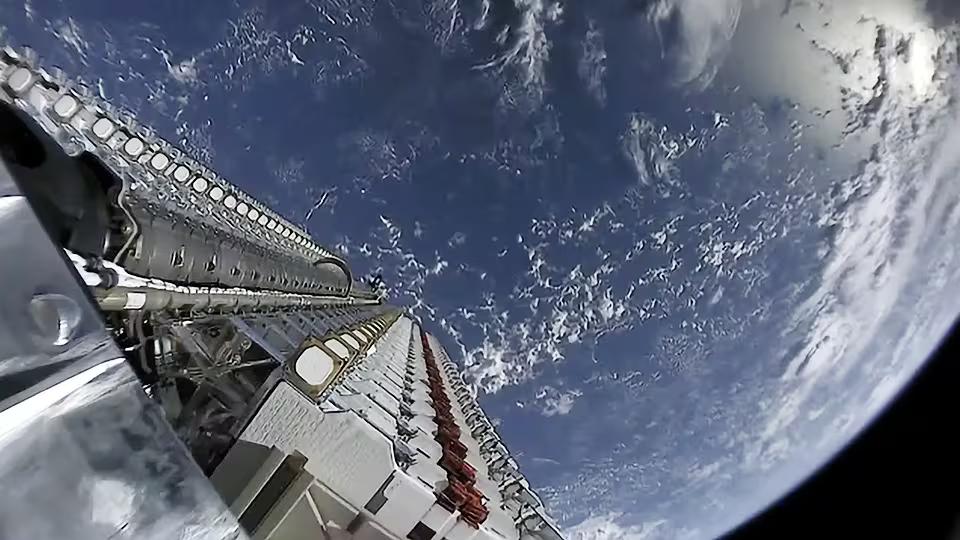
On 23 May 2019, a Falcon 9 first stage lit up the night sky over Cape Canaveral and climbed into a 440 km parking orbit. Sixty stacked satellites, each about the size of a folding table and weighing 227 kg, separated from the upper stage in a slow tumbling cloud roughly 24 hours later. To stargazers on the ground the next few evenings, they looked like a string of pearls drifting silently across the constellations: a brand new technology marching west to east in formation, soon nicknamed the "Starlink train". Most observers had no idea what they were looking at.
Six years later, more than 10,000 Starlink satellites have followed the first 60 into orbit, around 10,280 of them are still working, and Starlink is by a wide margin the largest spacecraft operator in the history of human spaceflight. The constellation handles internet traffic for over 10 million subscribers in roughly 155 countries and territories, has rewritten the economics of satellite broadband, and forces every other operator in low Earth orbit, including NASA running the International Space Station, to think about close approaches in a way that nobody did a decade ago.
This is the story of how it got there: the long lineage of failed attempts that came before it, the engineering choices that made it work where others did not, and the very real tensions, with astronomers, with regulators, with anyone trying to share the sky, that come with putting that many objects so close to home.
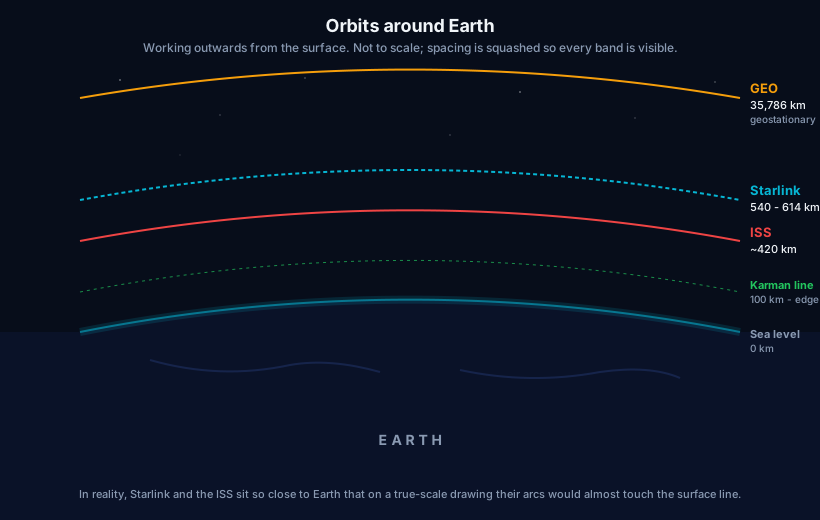 Where Starlink fits in the wider orbital landscape. Sitting roughly 65 times closer to the ground than a geostationary satellite is the single fact that makes the whole constellation work.
The long, expensive prelude
The idea of a swarm of low-flying satellites delivering data to small antennas on the ground is older than most readers think. The first serious attempt was Iridium, conceived in 1987 by three Motorola engineers, Bary Bertiger, Raymond Leopold and Ken Peterson. Motorola signed a fixed-price contract in July 1993 to deliver the constellation by November 1998, and incredibly, Iridium met that deadline. Between 1997 and 1998 Motorola launched 95 satellites on Delta II, Proton-K and Long March rockets, at one point producing a new spacecraft every 4.3 days. At full strength, 66 active satellites in six near-polar planes at 781 km gave Iridium something no one else had: handheld voice service from anywhere on the planet, including the poles.
It also cost about five billion dollars and went spectacularly bankrupt within nine months of commercial launch. The handsets were the size of bricks, the calls were expensive, and the late 1990s mobile-phone boom on the ground destroyed the market for global satellite voice before Iridium had a chance to recoup. In the end, the constellation survived the company, taken over by a new entity that kept selling to journalists, sailors and the U.S. military.
Globalstar, founded in 1991 by Loral and Qualcomm, made a similar bet at almost the same time and ran into the same wall. Its first satellites launched in February 1998. A Zenit rocket failure that September dropped 12 of them into the Pacific. Commercial service started in late 1999, the company filed for Chapter 11 in February 2002, and the satellites later began to lose their S-band amplifiers from radiation in the South Atlantic Anomaly.
The most relevant ancestor for Starlink was Teledesic, announced in March 1994 with seed money from Bill Gates, Craig McCaw and Saudi prince Alwaleed bin Talal. Teledesic promised "fibre-like" links to small antennas through a constellation of 840 satellites at 700 km, later scaled down to 288 satellites at 1,400 km, costing over nine billion dollars. A single demonstration satellite, BATSAT, launched on a Pegasus rocket in February 1998 and reentered in 2000 having proved very little. Teledesic suspended its construction work in October 2002. Its founders had been almost exactly right about the architecture; they were too early on the rockets, the electronics and the demand.
For the next decade and a half, satellite internet meant slow, high-latency geostationary services like HughesNet and Viasat, parked 35,786 km above the equator. A signal had to travel up and back down, a round trip of nearly half a second at the speed of light, before any application could respond. Video calls were unusable. Online gaming was a joke. Even loading a modern web page felt sluggish.
The pieces needed to do better, cheap mass-produced launch, cheap mass-produced satellites, electronically steered antennas affordable enough to put on a customer's roof, and a regulator willing to authorise tens of thousands of objects in space, did not exist all at once until the mid-2010s. That is the moment SpaceX moved.
From Tintin to the first Starlink train
Elon Musk announced the concept of a "Internet in space" at a satellite industry event in Seattle in January 2015, in the same week he opened a new SpaceX office in Redmond, Washington. The original public pitch was a 4,000-satellite constellation, an order of magnitude smaller than what flies today, and aimed initially at high-altitude orbits around 1,100 km. SpaceX filed with the U.S. Federal Communications Commission in November 2016 and quietly began work in parallel on the satellite bus.
Two prototypes called Tintin A and Tintin B launched as ridealongs on a Falcon 9 carrying the Spanish Paz radar satellite from Vandenberg on 22 February 2018. They were small, experimental, and never opened for service, but they showed that SpaceX could put up the Ku-band phased-array hardware it intended to use, run it from Redmond, and keep it pointed.
The first batch of 60 operational satellites flew on 23 May 2019 from Cape Canaveral. Designated v0.9, they were heavier and stripped-down compared with what would come later: 227 kg each, krypton-fuelled Hall-effect thrusters for station-keeping and end-of-life de-orbit, a single solar array, no inter-satellite links. They were also the moment everybody outside the satellite industry suddenly took notice. Sky-watchers across Europe filmed the train of new objects glinting in line astern across the sky. The astronomy community recoiled. SpaceX's manufacturing line in Redmond was already ramping toward what would become, briefly, six satellites a day.
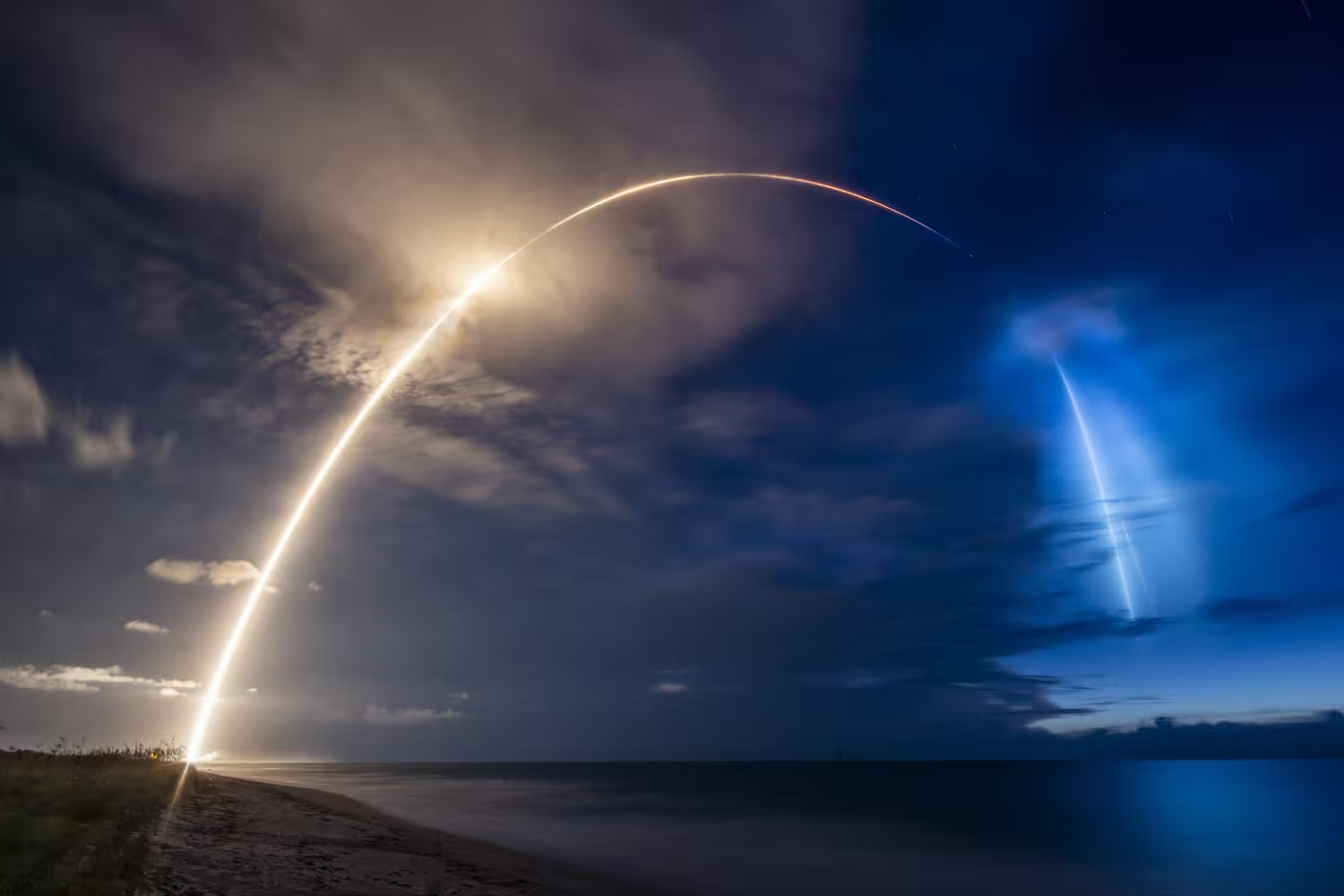 A Starlink launch at twilight from Cape Canaveral. The bright arc is the Falcon 9 climbing to orbit; the ghostly blue plume to the right is the first stage burning back to land on a drone ship out at sea. Image: SpaceX.
Then the version numbers blurred. The v1.0 satellites that started flying in November 2019 added Ka-band antennas and bumped mass to 260 kg. From January 2020 SpaceX experimented with a darker, anti-reflective coating on a single test article called DarkSat, then with a deployable sunshade on a fleet of "VisorSat" satellites from mid-2020 onward. Each batch of 60 satellites travelled to its assigned orbital plane on its own krypton thrusters, taking weeks. The first commercial customers signed up in late October 2020.
The third major design, v1.5, debuted on 24 January 2021 on a launch that also broke the world record for satellites on a single rocket: 143 of them. v1.5 satellites carry the first generation of optical inter-satellite links - lasers, in plain English, three per spacecraft - and weigh about 295 kg. From September 2021 the sunshades were dropped because SpaceX could finally orient each satellite to keep the bright underside out of the Sun while still completing its orbit-raising manoeuvres. Mass at this point becomes a moving target because each new batch quietly tweaks the design.
The v2 Mini satellites that started flying in February 2023 are bigger again, around 800 kg, with three full Ka- and E-band gateway antennas, five Ku-band user phased arrays, three optical lasers operating at up to 200 Gbps each, and a switch from krypton to argon for the thrusters. SpaceX has since claimed the v2 Mini is the first argon-propelled spacecraft in history. The full V2 satellites that need a Starship-class rocket to launch are heavier still, around 1,250 kg per Wikipedia's tabulated launch masses, and have not yet flown in volume because Starship has not yet reached operational service.
Anatomy of a flat-pack satellite
A Starlink satellite is, on purpose, the most boring spacecraft you could possibly build. There is no science payload. There is no fancy thermal cycle for a far-infrared detector. There are no high-priced reaction wheels qualified for fifteen years on station. There is a flat, rectangular bus that can be stacked dozens deep inside a Falcon 9 fairing, two body-mounted solar arrays that fold flat for launch and deploy like a fan once on orbit, and just enough avionics, propulsion and antennas to do exactly one job: route packets.
Five Ku-band phased-array antennas on the Earth-facing side handle the link down to user terminals. Three more dual-band antennas, covering the wider Ka- and E-band gateway frequencies, exchange traffic with SpaceX's ground stations. There is no big steerable dish anywhere on the spacecraft. Phased arrays steer their beams electronically by changing the phase of the signal across a flat patch of hundreds of small radiators, so the satellite itself never has to turn to chase a user on the ground.
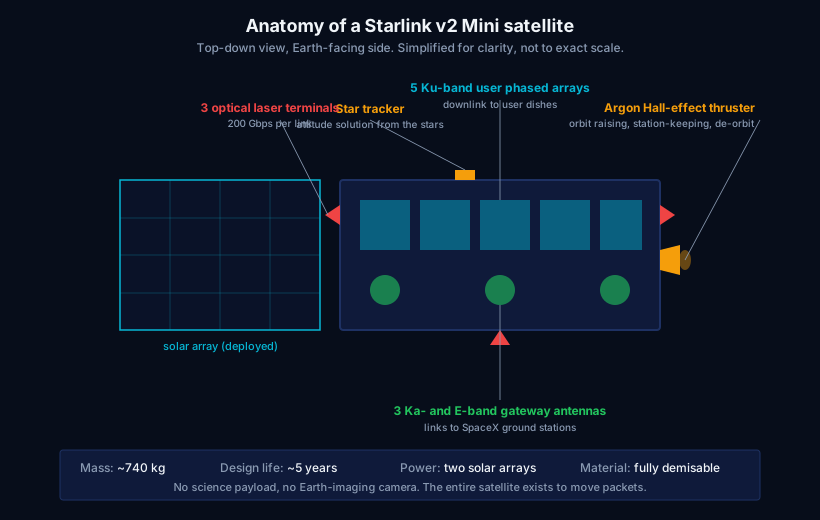 Simplified top-down view of a Starlink v2 Mini, looking down at the Earth-facing side. There is no science payload. The whole spacecraft exists to move packets.
Three optical inter-satellite laser terminals are the genuinely new piece of engineering. Each laser can carry around 200 Gbps. The terminals find their partners by sweeping, then lock on and hold the link as both satellites speed past one another at roughly 7.5 km/s. Together they turn the constellation into a global mesh: a packet picked up over Tokyo can travel from Starlink to Starlink in space and drop down at a gateway over California without ever touching submarine cable. For places that have no fibre at all, ships, polar regions, the middle of the Sahara, the lasers are the part that makes Starlink genuinely different.
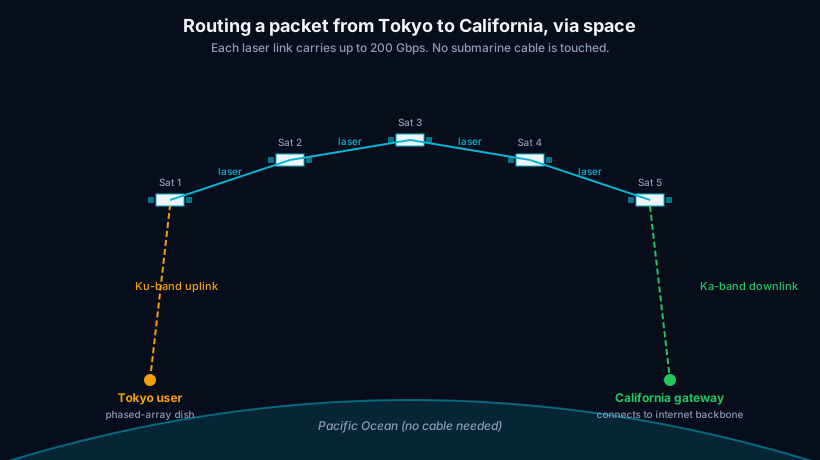 The laser mesh in action. A packet from a user in Tokyo can hop satellite to satellite in space and land at a gateway in California without ever touching a submarine cable. That capability is what makes Starlink genuinely different from every constellation that came before it.
Propulsion is now an argon-fed Hall-effect thruster. Argon is far cheaper than krypton, which matters when you are launching thousands of satellites a year, but it is also harder to ionise efficiently, which is why nobody had used it on orbit before. Star trackers pointed at the night sky give the satellite its own attitude solution. Four reaction wheels in a "hot-spare" configuration provide the slow nudges that keep the antennas facing Earth and the solar panels facing the Sun. Every part of the satellite, including those reaction wheels and their aluminium flywheels, is designed to break up and burn entirely in the upper atmosphere when the spacecraft is finally de-orbited. SpaceX calls this "demisable" design, and it is one of the few good news stories in the otherwise grim debate about satellite reentries.
Shells, ground stations, latency
The operational constellation is organised into shells: groups of satellites sharing a single altitude, inclination and pattern. The first shell, Group 1, sits at 550 km and 53.05 degrees inclination, with 1,584 satellites in 72 planes of 22 each. Group 2 fills in polar coverage at 570 km and 70 degrees, Group 3 sits in true sun-synchronous polar orbit at 560 km and 97.6 degrees, and Group 4 lays a denser carpet at 540 km and 53.22 degrees. The Generation 2 architecture adds further shells at slightly different altitudes between 530 and 614 km.
The numbers behind the latency advantage are worth holding in your head. A geostationary satellite is 35,786 km up. A signal cannot travel faster than 300,000 km/s, so a round trip from user to satellite and back is at least 240 ms even before the gateway link and the wider internet get involved. In practice GEO services land at 600 ms or worse. A Starlink satellite at 550 km is roughly 65 times closer. The theoretical round trip drops to about 4 ms, and a fully measured connection from a user terminal in Texas to a server in California, gateway and ground hops included, lands around 25 to 35 ms. That is fast enough for video calls, fast enough for online gaming, fast enough that you can forget you are talking to space at all.
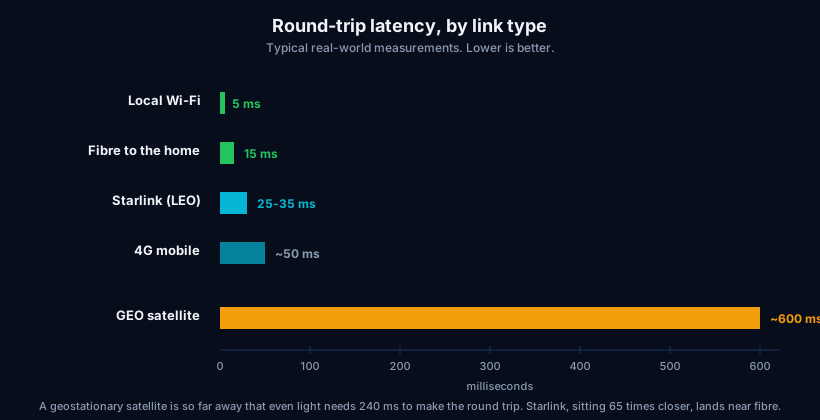 Round-trip times for typical link types. The geostationary bar dwarfs everything else, which is the whole reason traditional satellite broadband was unusable for video calls. Starlink lands in the same ballpark as fibre.
User terminals do the rest. The first-generation "Dishy McFlatface" was a circular self-aligning phased array about 60 cm across. Later "Standard" and "Mini" terminals are rectangular and progressively cheaper and lighter. The terminal points itself at the sky on first power-on, picks out the satellites currently passing overhead, and forwards packets through whichever one has the best link at any given moment. Handover from one satellite to the next happens in the background every couple of minutes.
Sharing the sky with the ISS, and everything else
In low Earth orbit, things go very fast. Two objects on conflicting paths can meet at relative speeds of more than 14 km/s. The 2009 collision between Iridium 33 and the dead Russian satellite Kosmos 2251, at 16:56 UTC on 10 February that year, hit at roughly 35,000 km/h and produced more than 2,000 trackable fragments. That single accident still litters orbits between 500 and 1,000 km today.
Starlink puts more spacecraft into orbit than every other operator combined. The constellation could not exist without strict, automated traffic management. Each Starlink satellite carries GNSS receivers to know exactly where it is, the ion thrusters to move itself, and an onboard autonomous collision avoidance system. SpaceX shares high-precision ephemeris files publicly, so other operators can plug them into their own conjunction screening. SpaceX has also progressively lowered its own threshold for moving. It now manoeuvres a satellite when the probability of collision with any tracked object hits one in a million, a hundred times stricter than the industry-standard one-in-ten-thousand.
Those numbers have consequences. Between December 2023 and May 2024, the constellation flew around 50,000 collision-avoidance manoeuvres, roughly 275 a day. By 2025 the rate had climbed sharply: SpaceX disclosed to the U.S. Federal Communications Commission that the fleet performed roughly 300,000 collision-avoidance manoeuvres across that calendar year, an average of nearly 40 per satellite. SpaceX attributes much of the increase to the tightened one-in-a-million threshold; independent space-sustainability researchers, notably Hugh Lewis at the University of Southampton, broadly agree but note that the absolute manoeuvre rate is climbing as the constellation grows.
The ISS itself is largely out of harm's way. The station orbits at about 420 km and 51.6 degrees, well below the lowest Starlink shell. NASA and SpaceX signed a Joint Spaceflight Safety Agreement on 18 March 2021 that formalises the data exchange. The rule it codifies is simple: if a close approach is predicted between Starlink and a NASA asset, SpaceX moves and NASA holds. That avoids the absurd outcome where both sides manoeuvre into each other. The ISS has never had to dodge a Starlink satellite specifically, although the station has executed avoidance burns for other debris and dead spacecraft over the years.
| Constellation | Orbit altitude | Active satellites at peak | Status today |
|---|---|---|---|
| Iridium (original) | 781 km, 86.4 degrees | 66 (plus spares) | Replaced by Iridium NEXT, 75 active |
| Globalstar | 1,414 km, 52 degrees | 48 originally, 25 in Gen 2 | Operational, joining Amazon group |
| Teledesic | 1,400 km (planned) | 0 | Cancelled 2002, one demo flight only |
| Starlink Gen 1 | 540 to 570 km, 53 to 97.6 degrees | 2,800+ operational | Active |
| Starlink Gen 2 | 530 to 614 km, 43 to 97 degrees | 6,300+ operational | Active and growing |
The brightness problem, and what is being done about it
Astronomers spotted the issue within hours of the first Starlink train. A satellite at 550 km is close enough and broad enough to reflect a noticeable amount of sunlight in the hour or two after sunset and before sunrise. Stacked freshly into a thin line, they ruined wide-field astronomy exposures and left streaks across photographs of comets, asteroids and faint galaxies.
SpaceX responded faster than it usually gets credit for. The DarkSat coating flown in January 2020 was an early, partial fix. The deployable sunshade on VisorSat from August 2020 cut peak brightness more reliably. From v1.5 onwards SpaceX uses a combination of black, low-reflectivity paint, a "knife-edge" attitude that hides the bright underside from the Sun whenever possible, and dielectric mirror films on the most reflective surfaces. The widely-cited brightness target is apparent magnitude 7, the threshold below which professional ground-based observatories begin to lose data, and most operational Starlinks now sit at or below that level once they reach their final orbit.
It is not a solved problem. Freshly launched satellites still trace bright lines for the first few days while they raise their orbits. The much larger V2 spacecraft are intrinsically brighter than the V1 generation. Wide-field optical surveys like the Vera C. Rubin Observatory's LSST will be measurably affected for the next decade at least. The night sky is, in a meaningful sense, no longer pristine for anyone on Earth.
End of life: the five-year rule
Every Starlink satellite is designed to be temporary. The 540 km operational orbit has just enough residual atmosphere to drag a dead, unpowered satellite down to reentry within about five years. A healthy spacecraft does not wait that long. When SpaceX decides it has reached end of life, the satellite lowers itself to a parking orbit, holds station while traffic peaks below it clear, and then makes a final propulsive burn to drop into the atmosphere on a controlled trajectory. The wider goal is for nothing to survive reentry. Reaction wheels and pressure vessels, the two parts most likely to hit the ground intact, have been redesigned to break up in the heat.
In January 2026 SpaceX announced it would lower around 4,400 of its existing satellites from 550 to 480 km over the course of the year. The change cuts orbital lifetime even further, makes the constellation easier to dispose of in failure cases, and reduces collision probability for everyone else. As a side effect, Starlink reentries are now a near-daily occurrence. On a typical week in 2025, two or three older Starlinks burnt up over the southern oceans.
What it means for the trackers on this site
This site runs a live Starlink constellation tracker that draws every active satellite in real time, against the same map and globe that powers the ISS view. Roughly 6,000 satellites are propagated locally in the browser using SGP4, the same orbital model that professional pass-prediction tools rely on, seeded from the latest Two-Line Element catalogue published by Space-Track.org. The TLE set is refreshed every 12 hours through a caching layer so that your browser only ever makes one batched API call, never thousands of individual ones. Positions on screen tick forward every 30 seconds.
The tracker offers both a photorealistic 3D Cesium globe and a flat 2D map, with a toggle in the top right. The 3D view is the one that makes the shell structure obvious: tilt the globe and you can see the orbital planes laid out like the seams of a tennis ball, all sloping at the constellation's characteristic 53 degrees. Switch to 2D and the same satellites resolve into the familiar sinusoidal ground tracks, sweeping east-to-west across the planet at roughly 27,000 km/h.
If you have ever watched the live ISS map and noticed faint strings of new objects sliding past it, you have probably seen Starlinks fresh off a launch. In the days after a launch, while the new batch is still flying in formation and orbit-raising, the train is visible to the naked eye if the geometry works out. The next-pass calculator will compute when a specific Starlink (or the ISS) will fly over your location, the Earth gallery shows astronaut photographs from the very station that flies underneath the constellation, and the whos in space page tells you who is on board it right now.
The relationship between Starlink and the ISS is mostly one of polite separation. The station is below them. The lasers above it carry data the crew now use for daily comms uplinks. The fact that the world's biggest satellite operator, the world's only continuously crewed laboratory in orbit, and a debris environment shared by everyone all coexist in low Earth orbit without major incident is a quiet engineering triumph in its own right. It is also a fragile one. Every additional megaconstellation, and there are several on the way, raises the stakes.
Things You Might Not Know
| Fact | Detail |
|---|---|
| First in argon | The v2 Mini was the first spacecraft ever to fly an argon-fuelled Hall-effect thruster on orbit. Earlier Starlinks used krypton, which is easier to ionise but several times more expensive. |
| The Tintin twins | The first two test satellites in 2018 were officially Microsat-2a and -2b, but Elon Musk nicknamed them Tintin A and Tintin B after the Belgian comic-book reporter. |
| 143 in one go | The Transporter-1 rideshare on 24 January 2021 broke the world record for satellites launched on a single rocket. Ten of them were polar Starlinks. India's ISRO had previously held the record at 104. |
| Laser-to-laser handover | A single Starlink-to-Starlink laser link can hold lock across roughly 5,400 km, the maximum geometry of two satellites on opposite ends of the same orbital plane. |
| The lowest altitude shell | Of SpaceX's currently authorised satellites, the lowest planned shell sits at just 340 km. None has yet been deployed there; the constellation has so far stayed safely above the ISS. |
| Two reentries a day | In a typical 2025 week, between 14 and 20 Starlinks burnt up in the atmosphere as old satellites were retired. Almost all reentries are over open ocean. |
| Ten million customers | SpaceX confirmed Starlink had passed 4 million subscribers in September 2024, 5 million by mid-2025, and 10 million by February 2026, with service now reaching roughly 155 countries and territories. |
| It started with a tweet | Elon Musk publicly tested the network in October 2019 by posting to Twitter through it. The first tweet over Starlink read: "Whoa, it worked!!" |
| ISS still has the better view | The Cupola windows give astronauts a fundamentally clearer view of Earth than any Starlink camera does. The constellation has no Earth-imaging payload at all. Starlink's job is packets, nothing more. |
Related Reading
- Tracking the ISS: why its orbit, altitude and speed constantly change the same physics that governs every Starlink shell.
- Orbiting awkwardly: diplomacy on the space station what happens when commercial constellations meet international politics 400 km up.
- Five things you didn't know about the ISS for context on what is up there alongside the megaconstellations.
Sources: SpaceX's own Starlink Technology page, the SpaceX-NASA Joint Spaceflight Safety Agreement, the U.S. FCC's published constellation status reports, Jonathan McDowell's Starlink statistics page, Space.com's reporting on 50,000 collision-avoidance manoeuvres, and Wikipedia's heavily cited articles on Starlink, Iridium, Globalstar and Teledesic.