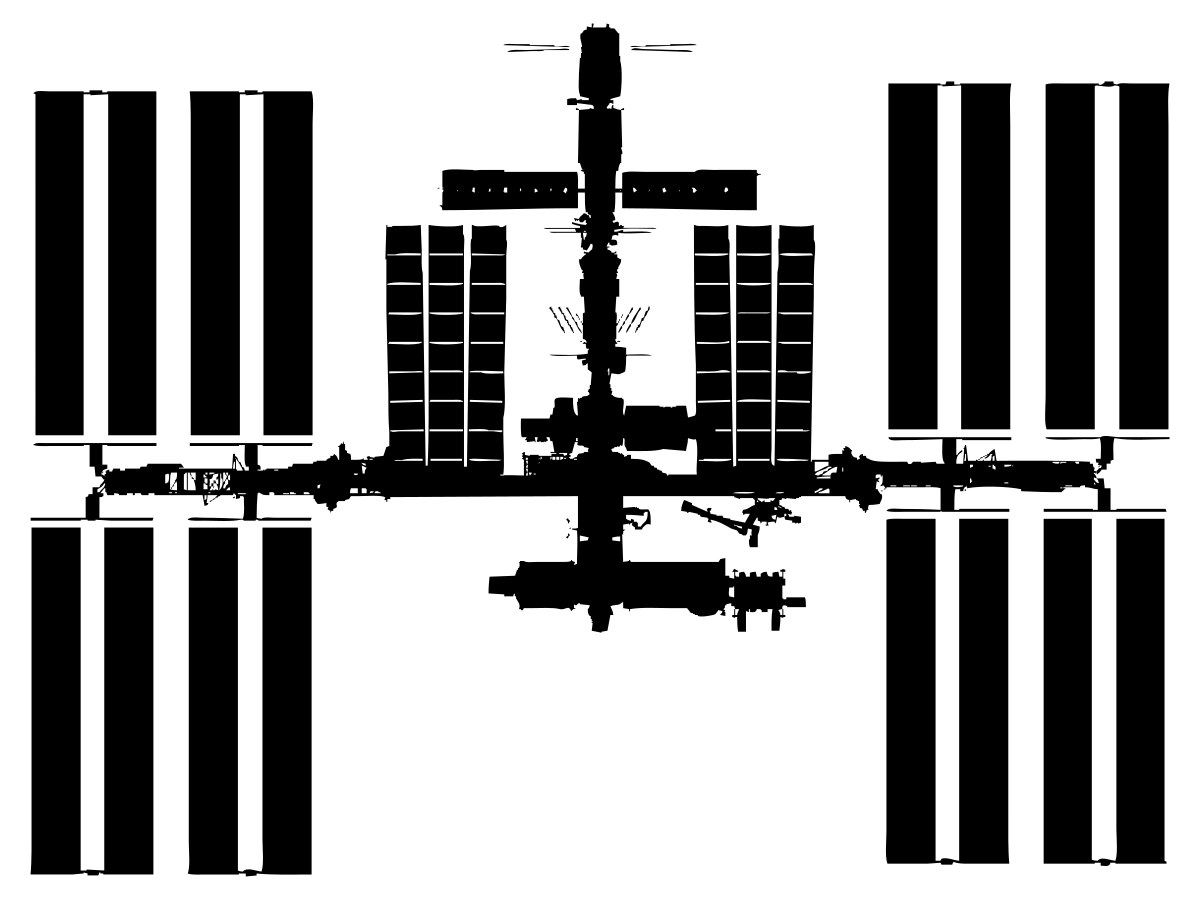


When will the ISS pass over me?
Find out exactly when the International Space Station will next be visible from where you are standing. Enter a city name in the search box below, or tap Use my location to read your coordinates directly from your browser. We will list the next several visible passes ranked by quality, including the start time, direction in the sky, duration, and how high above the horizon the station will rise.
The same predictor works for the Chinese Tiangong space station, the Hubble Space Telescope, and other satellites we track. Switch between them using the controls inside the predictor.
How ISS pass predictions work
The International Space Station orbits Earth at roughly 28,000 km/h and at an altitude of around 420 km. From the ground it appears as a bright, fast-moving point of light that crosses the sky in a few minutes. To predict whether you will be able to see it, we need three things: the latest orbital data for the ISS, your location on Earth, and the position of the Sun.
We start with the most recent Two-Line Element set published by Space-Track.org and run it through the SGP4 propagator to compute where the ISS will be at every minute of the next several days. For each minute we calculate the angle from your location to the station; if the station is above the horizon and the Sun is far enough below your local horizon (so the sky is dark) but still illuminating the station, that minute is part of a visible pass.
The predictor groups consecutive visible minutes together as a single pass, computes the maximum elevation, and ranks each pass from poor to excellent based on how high it gets and how long it lasts. Use the times shown to step outside a couple of minutes early and look towards the indicated horizon.
Reading the results
Maximum elevation is the highest point above the horizon the station reaches during the pass, measured in degrees. 90° is directly overhead. Anything above 40° is genuinely impressive; below 10° the station will likely be hidden by buildings or trees.
Direction tells you which part of the horizon the station rises from and which it sets into. If a pass starts in the SW (southwest) and ends in the NE (northeast), face roughly south at the start time and follow the station as it tracks across the sky.
Duration is the total time the station is above your horizon and illuminated by the Sun. Most visible passes last between two and seven minutes.
Frequently asked questions
- How do I know when the ISS will pass over my house?
- Use the pass predictor on this page. Allow location access or enter your coordinates manually. The tool calculates upcoming visible passes using orbital data and shows the time, direction, and maximum elevation for each pass over your location.
- What elevation makes a good ISS pass?
- A maximum elevation above 40 degrees is considered excellent and the station will be very bright. Between 20 and 40 degrees is good. Below 20 degrees the station may be partially blocked by buildings, trees, or the horizon.
- How bright is the ISS?
- During a high overhead pass the ISS can reach magnitude -4 or brighter, making it the third-brightest object in the sky after the Sun and the Moon. It looks like a steady, fast-moving white dot. It does not flash or have coloured lights, so it cannot be confused with an aircraft.
- How long does an ISS pass last?
- Most visible passes last between two and seven minutes from when the station rises above the horizon to when it sets again. The exact duration depends on how high the pass is above your local horizon; an overhead pass lasts longer than a low one.
- Why does the ISS sometimes disappear during a pass?
- The ISS is only visible because it reflects sunlight. When it crosses into Earth’s shadow mid-pass, it abruptly becomes invisible. This happens most often around dawn and dusk passes and is a normal part of low Earth orbit visibility.
- Can I see the ISS during the day?
- Almost never. The sky is too bright for the unaided eye to pick out the ISS during daylight, even though it is technically still up there. The best viewing windows are 60 to 90 minutes before sunrise and after sunset, when the sky is dark but the station is still in sunlight.
URL parameters and JSON output
This page can be driven entirely from its URL, which makes it easy to bookmark a location or wire into automations such as iOS Shortcuts, home dashboards, and scripts. With coordinates in the URL the predictor loads your results immediately; add format=json and instead of the web page you receive a machine-readable summary of the single next matching pass. All parameters are optional and none of them change how the page itself behaves.
| Parameter | Values | Meaning |
|---|---|---|
| lat | -90 to 90 | Latitude in decimal degrees. Required for JSON output. |
| lon | -180 to 180 | Longitude in decimal degrees. Required for JSON output. |
| sat or satellite | iss (default), tiangong, hubble, or a NORAD id | Which spacecraft to predict passes for. |
| type | visible (default), radio, all | Which passes count for JSON output: naked-eye visible only, radio-only overflights, or every pass. |
| format | json | Return the next matching pass as JSON instead of this web page. |
For example, the next visible ISS pass over central London:
https://issinfo.net/next-pass?lat=51.5072&lon=-0.1276&format=json
returns a response shaped like this:
{
  "satellite": { "name": "ISS", "norad": 25544 },
  "type": "visible",
  "location": { "lat": 51.5072, "lon": -0.1276 },
  "lookaheadDays": 10,
  "generatedAt": "2026-07-16T13:50:51Z",
  "pass": {
    "start": "2026-07-16T21:02:03.000Z",
    "peak": "2026-07-16T21:07:27.000Z",
    "end": "2026-07-16T21:12:53.000Z",
    "startUTC": 1784235723,
    "peakUTC": 1784236047,
    "endUTC": 1784236373,
    "durationSeconds": 600,
    "maxElevation": 86.9,
    "startDirection": "W",
    "peakDirection": "SSW",
    "endDirection": "E",
    "visible": true,
    "quality": "excellent",
    "magnitude": -3.2,
    "inProgress": false
  }
}
Times are given both as ISO 8601 UTC strings and as Unix epoch seconds. If no matching pass occurs in the next 10 days, pass is null and a message field explains why. The endpoint allows cross-origin requests, so you can call it directly from a browser-based app.