

NASA's Moon Base: America's First Outpost on Another World
On May 26, 2026, photographers crowded around a long table in the Mary W. Jackson NASA Headquarters building in Washington. On the table sat four scale models: a Blue Origin Mark 1 lunar lander, an Astrolab crewed rover, a Lunar Outpost Pegasus rover, and a Firefly Elytra Dark orbiter. NASA Administrator Jared Isaacman and a soft-spoken engineer named Carlos Garcia-Galan stood behind them. Two months earlier, at an event called Ignition, NASA had told the world it was abandoning its lunar space station and building a surface base instead. This was the day the agency started signing the cheques.
"The Moon Base will be America's and humanity's first outpost on another celestial world," Isaacman said. "Every mission, crewed and uncrewed, will be a learning opportunity as we return to the lunar surface, build the infrastructure to stay, and master the skills required to live and operate in one of the most demanding and dangerous environments imaginable."
The Moon Base is the most ambitious thing NASA has committed to in a generation. It is also, in plain English, a real plan with real contracts attached, not the kind of glossy concept slide that has so often replaced action over the past twenty years. Here is what NASA is actually building, where, when, with whom, and why.
A pivot at the Ignition event
The story of the Moon Base properly starts on March 24, 2026. Inside the Webb Auditorium at NASA's Washington headquarters, in front of about 160 industry leaders, foreign space agency chiefs and politicians, Isaacman unveiled what NASA called Ignition: a slate of agency-wide initiatives meant to deliver on President Donald Trump's December 2025 "Ensuring American Space Superiority" Executive Order.
Two announcements that day shocked the room. First, NASA was cancelling the Lunar Gateway, the small space station it had been planning to assemble in a halo orbit around the Moon with European, Japanese and Canadian partners. Second, every dollar and engineer that had been pointed at Gateway would now be pointed at the surface. The new objective was a permanent, continuously crewed base near the lunar South Pole, with first elements landing in 2026 and continuous human presence by 2032.
"For too long we tried to satisfy every stakeholder," Isaacman said at Ignition, in remarks reported by Ars Technica. "Billions of dollars wasted. Years lost. Hardware that never launched. Fewer flagship science missions. And fewer astronauts in space, which means fewer kids dressing up as astronauts for Halloween. I don't like it. The president doesn't like it. The American people have waited long enough."
The man given the job of turning that speech into hardware is Carlos Garcia-Galan, a 27-year NASA veteran who had been a deputy program manager on the very Gateway that was being cancelled. Isaacman, joking from the podium, called him the "Lunar Viceroy". His actual title is Moon Base Program Executive.
"Change is always hard," Garcia-Galan told Ars Technica in an interview the next day. "But it was not hard from the perspective of having the focus on doing something that's directly related to the objectives we have at hand, which are bringing humans back to the surface of the Moon and building an outpost."
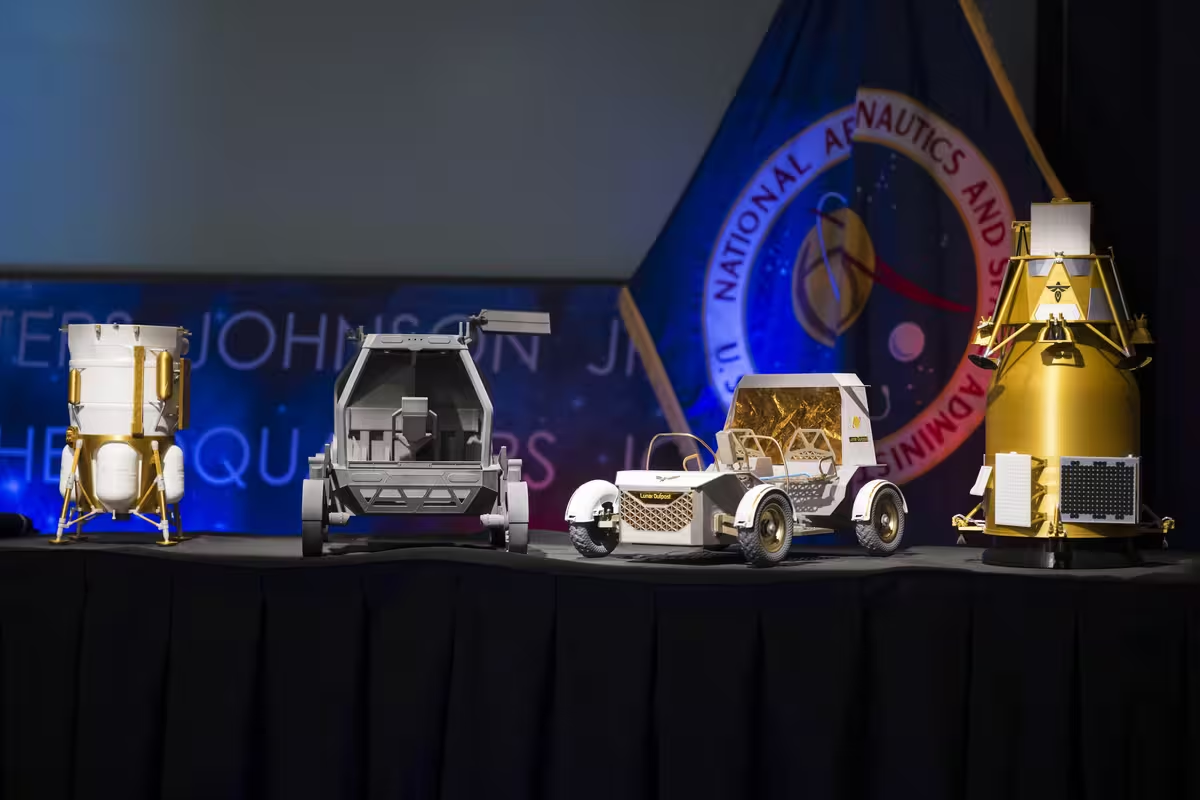 The first hardware of the Moon Base era. Scale models on display at the news conference at NASA Headquarters, Washington, May 26, 2026. Image credit: NASA/Aubrey Gemignani.
Why the South Pole
Every Apollo landing happened near the lunar equator. The Moon Base will not. NASA is targeting the rim of Shackleton Crater and the high ground known as the Connecting Ridge, both near the geographic South Pole.
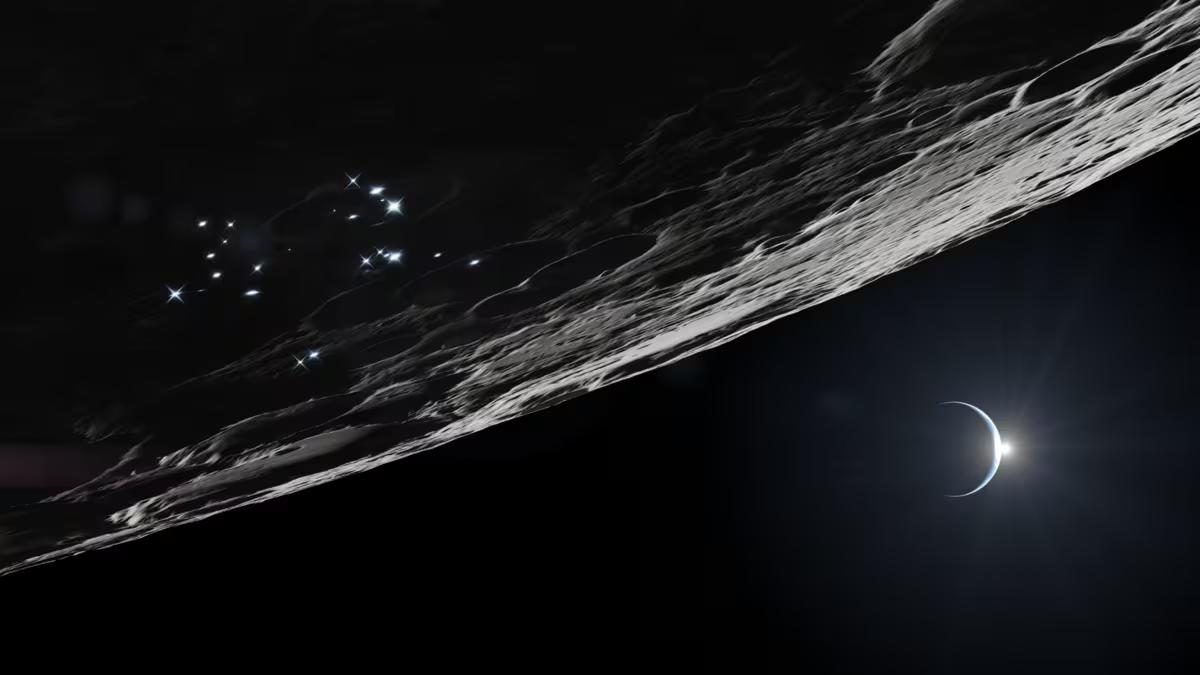
The reasoning is cold-blooded engineering. At the poles, the Sun never climbs high in the sky, but on certain high ridges it never quite sets either. Some of these "peaks of eternal light" stay illuminated for more than 80 percent of the lunar year. Solar power, the single hardest problem at any other lunar latitude, becomes much more tractable. A short walk away, deep inside craters that have not seen sunlight in billions of years, temperatures drop to as low as minus 334 degrees Fahrenheit (minus 203 degrees Celsius). Water ice, once carried in by comets and asteroids, is cold-trapped in those shadows. Mining and melting that ice for drinking water, breathable oxygen and rocket propellant is the whole reason to be at the pole.
Temperatures swing wildly. NASA's reference page lists ranges from above 130 degrees Fahrenheit (54 degrees Celsius) in sunlit patches down to minus 334 degrees Fahrenheit in the permanently shadowed craters just a few kilometres away. Shackleton Crater itself is more than twice as deep as the Grand Canyon, and its rim sits at roughly 89.9 degrees south.
The South Pole region also borders the South Pole-Aitken Basin, the oldest and largest impact crater in the solar system. Samples scooped from anywhere near it could rewrite what scientists know about the early bombardment that shaped Earth and the Moon. The Artemis II crew, on their lunar flyby in April 2026, photographed the eastern edge of the basin from close range.
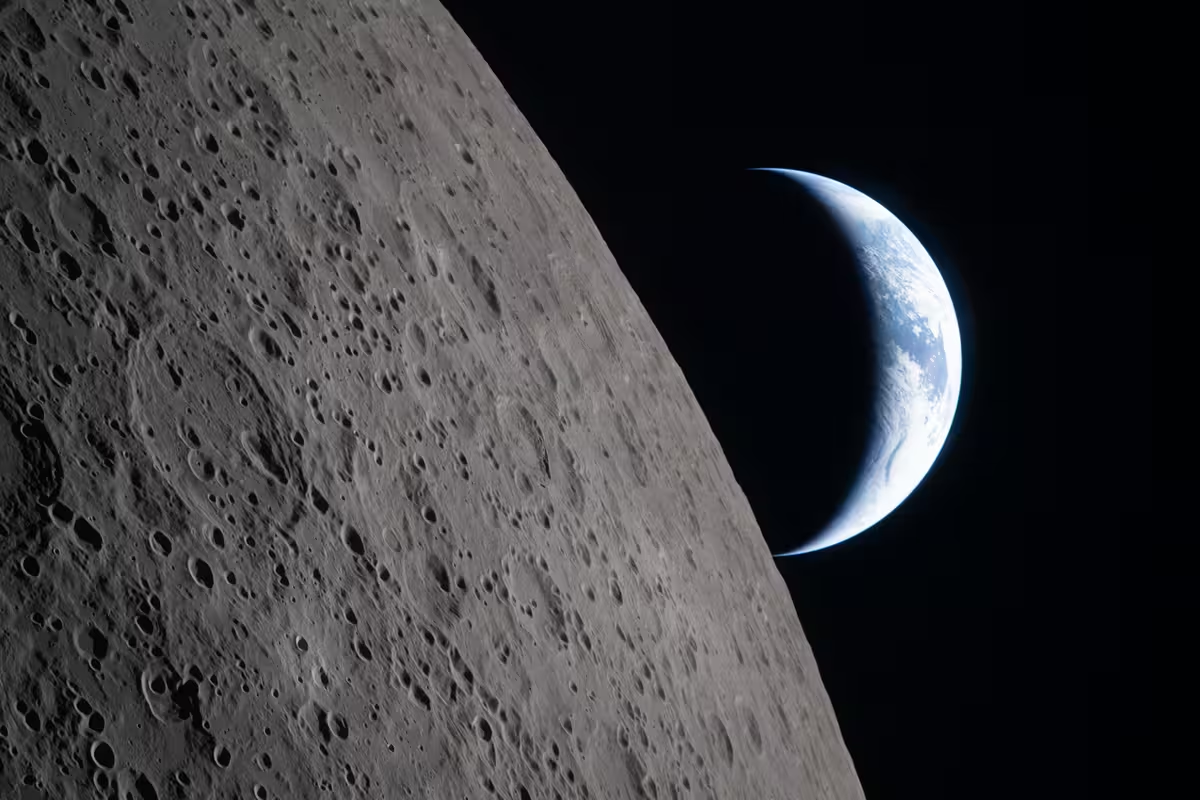 The eastern edge of the South Pole-Aitken Basin, the Moon's oldest and largest impact basin, photographed by the Artemis II crew on their April 2026 lunar flyby. Image credit: NASA.
Three phases, three decades' worth of work compressed into one
NASA's published architecture splits the Moon Base build into three phases. Each phase carries an internal budget forecast of around 10 billion dollars, Garcia-Galan told Ars Technica.
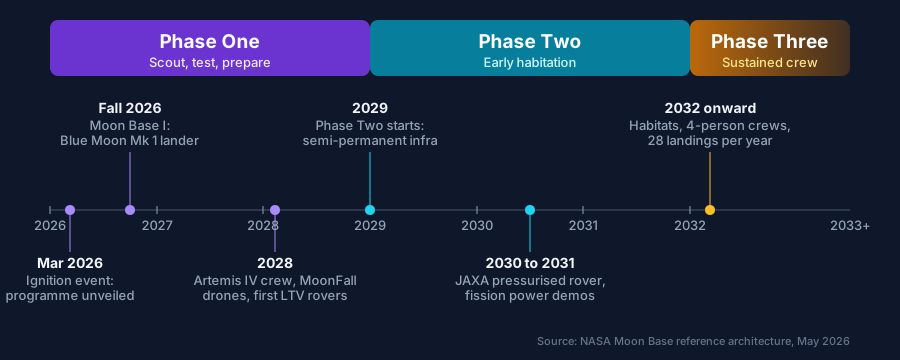 The Moon Base programme at a glance. Phase windows and milestone dates as published by NASA in March and May 2026.
| Phase | Window | Headline goal | Landings | Cargo to surface |
|---|---|---|---|---|
| One | Now to 2029 | Scout, test, prepare | Up to 21 | About 4 tonnes |
| Two | 2029 to 2032 | Early habitation, semi-permanent infrastructure | Up to 24 | Up to 60 tonnes |
| Three | 2032 onward | Sustained human presence | Roughly 28 a year by the end | Up to 38 tonnes per year |
Phase One is dominated by robots. NASA plans up to 25 missions, including 21 landings, before astronauts return to the surface on Artemis IV in 2028. The cargo flying down includes early lunar terrain vehicles, four short-range hopping drones called MoonFall, radioisotope heater units designed to keep hardware alive through the 14-Earth-day lunar night, and the long-delayed VIPER rover, NASA's first water-ice prospector.
Phase Two switches gear from scouting to building. Expanded solar arrays go down, joined by initial nuclear surface power, including small fission reactors. JAXA, the Japanese space agency, contributes a pressurised rover capable of taking astronauts a hundred kilometres or more from the base on multi-day traverses. Comms networks knit the site together. By the end of Phase Two, around 60 tonnes of cargo will have landed.
Phase Three is the one most people picture when they hear "Moon Base". Habitats with enough internal volume to live in for weeks at a time. Operational fission power running through the lunar night. Crewed and autonomous rovers shuttling supplies around an "industrial neighbourhood" with the beginnings of in-situ resource utilisation: pulling oxygen and water from regolith, casting structures out of melted Moon dust, perhaps even returning samples and used hardware to Earth aboard cargo landers. NASA's architecture targets crews of four astronauts on four-week rotations.
The cadence is the breath-taking part. NASA has never landed cargo on the Moon on the schedule it now intends to keep. "The cadence we previewed today is not in our experience base at NASA," Garcia-Galan admitted to Ars Technica. "It's very demanding. I think it's important, it's critical that we set it that way, to identify the stress points."
The first three missions
At the May 26 news conference, NASA put names and dates against the first three flights of the new programme.
Moon Base I is targeted for launch no earlier than fall 2026. It will fly on Blue Origin's Blue Moon Mark 1 lander, the same vehicle that took the company's "Endurance" pathfinder out to the Moon earlier in 2026. Onboard are the Stereo Cameras for Lunar Plume-Surface Studies, an instrument designed to film what happens to lunar regolith when a lander's thrusters fire into it, and the Laser Retroreflective Array, a passive optical target that lets orbiting spacecraft pin down a lander's position with centimetre-class accuracy. The landing site is the Shackleton Connecting Ridge, the same ground NASA wants Artemis astronauts to step out onto in 2028.
Moon Base II is planned for later in 2026 on Astrobotic's Griffin lander. It will carry more than 1,100 pounds (500 kilograms) of cargo, including Astrolab's FLIP rover, a precursor to the larger Lunar Terrain Vehicle.
Moon Base III will fly the first payload selected through NASA's Payloads and Research Investigations on the Surface of the Moon initiative. The anchor experiment, Lunar Vertex, will ride down on Intuitive Machines' Nova-C Trinity lander to investigate "lunar swirls", strange bright markings on the surface whose physics is still not understood. Payloads from the European Space Agency and the Korea Astronomy and Space Science Institute are flying with it, the first international hardware delivered under the Moon Base banner.
NASA also opened the contract floodgates. Astrolab received 219 million dollars to develop its CLV-1 crewed rover, derived from the company's FLEX architecture. Lunar Outpost received 220 million dollars for Pegasus, a lighter evolution of its Eagle rover with Apollo-heritage hardware. Both rovers are targeted to reach the lunar surface in 2028, in time for the first crewed Artemis surface landings. Astrolab quotes a mass of around 2,000 pounds (910 kilograms) and a top speed above 6 miles per hour for CLV-1; Lunar Outpost lists Pegasus at "more than 9 miles per hour" with up to a year of operational life and the ability to drive manually, autonomously, or remotely from Earth.
To get those rovers down, Blue Origin received 188 million dollars (with an option period worth a further 280.4 million dollars) for two CX-2 task orders under the Commercial Lunar Payload Services contract. The Mark 1 lander, originally a stretch goal for the company, has quietly become central to NASA's surface logistics.
The MoonFall drones, and the line they will draw on the Moon
The most visually striking piece of the Phase One hardware is also the most novel: four propulsive drones, built at NASA's Jet Propulsion Laboratory and ferried to lunar orbit by a Firefly Aerospace Elytra spacecraft. Each drone is about 7 feet (2.1 metres) in diameter, 4 feet (1.2 metres) tall, weighs roughly 550 pounds (250 kilograms) including propellant, and carries up to ten high-definition cameras plus a neutron spectrometer for sniffing out subsurface water, a radiation monitor and a laser retro-reflector.
After Elytra drops them mid-descent, each drone flies independently. Over the course of a single lunar day, around 14 Earth days, the four drones will make multiple short hops, photographing terrain that no rover could safely reach, including the inside walls of permanently shadowed craters. Current orbital imagery of most of the Moon is good to about one metre per pixel. MoonFall's Lunar Dashcam system aims for one centimetre per pixel, a hundred-fold improvement. Launch is targeted for 2028, ahead of the first crewed Artemis surface landing.
The clever bit is what happens after the propellant freezes solid in the first lunar night. Each drone is fitted with a survive-the-night payload that will go on transmitting through subsequent lunar daytimes, perhaps for months. Garcia-Galan was explicit about what NASA intends to do with them.
"We're hoping to establish a Moon Base perimeter with four or three lunar drones," he told reporters at the May 26 briefing. "We're going to be able to basically put them at the corners of the areas where we think we have either key scientific objectives, or we want to build up the Moon Base."
In their parked positions, the silent drones become beacons. Retro-reflectors let other spacecraft fix their location to the centimetre. Their radios could even act, in Garcia-Galan's words, as "the first lunar cell towers". And as the corners of a quadrilateral, they sketch out the first piece of human-marked territory on another world.
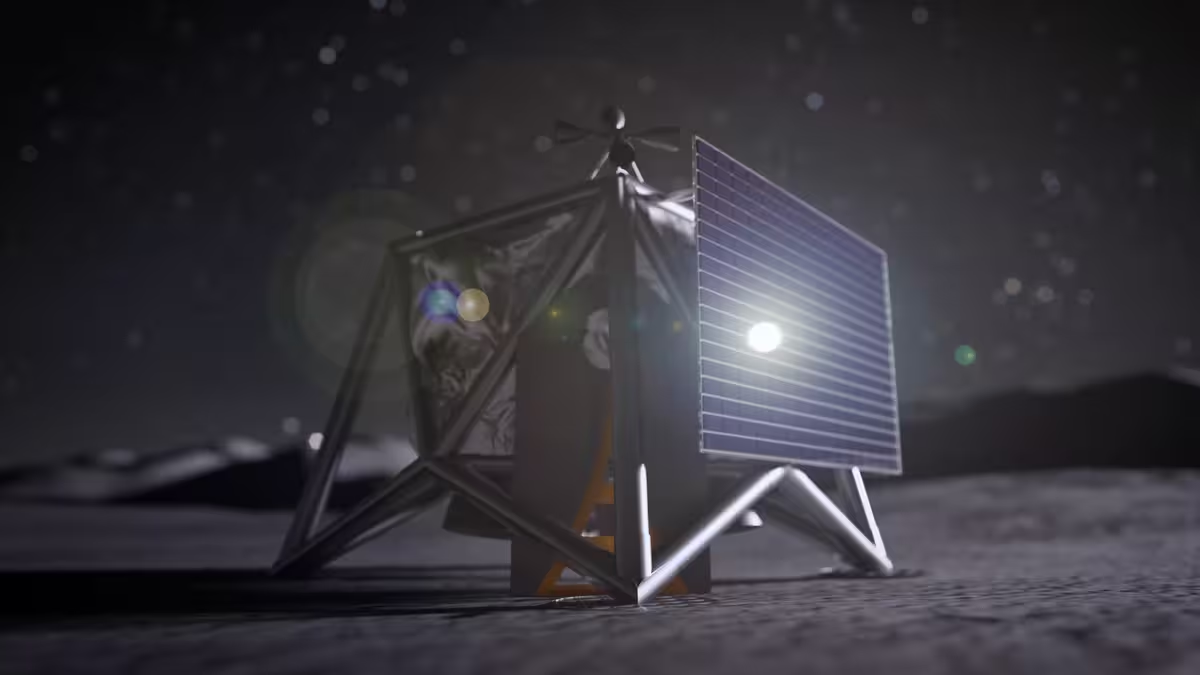 Concept art of a MoonFall drone on the surface near the lunar South Pole. JPL built the drones; Firefly's Elytra spacecraft will deliver them. Image credit: NASA/JPL-Caltech.
A perimeter, treaties, and China
That word, perimeter, raises hard legal questions. The 1967 Outer Space Treaty, signed by every spacefaring nation that matters, forbids any country from claiming sovereignty over territory on the Moon. Building a base does not change ownership. Planting a flag does not either.
The Artemis Accords, a NASA-led framework now signed by 67 countries, accept the Outer Space Treaty but introduce a softer concept: "safety zones", areas in which "harmful interference" with another nation's operations is not allowed. A MoonFall perimeter is, in practice, the first physical safety zone on the lunar surface. China, which is pursuing its own ambitious crewed lunar plans aimed at the same South Pole region with the International Lunar Research Station, has been openly critical of the safety zone idea.
Asked directly whether the perimeter was a safety zone, Isaacman would not commit. "There are areas of great interest on the lunar surface, and we do want to get there and explore them," he said. "We also obviously want to be very mindful of the Outer Space Treaty, so that we are respectful of other nations that are putting assets on the lunar surface. We would expect that to be reciprocal."
Translation: NASA is going to draw lines on the Moon, the rest of the world is going to have to decide what those lines mean, and the next few years are going to be interesting.
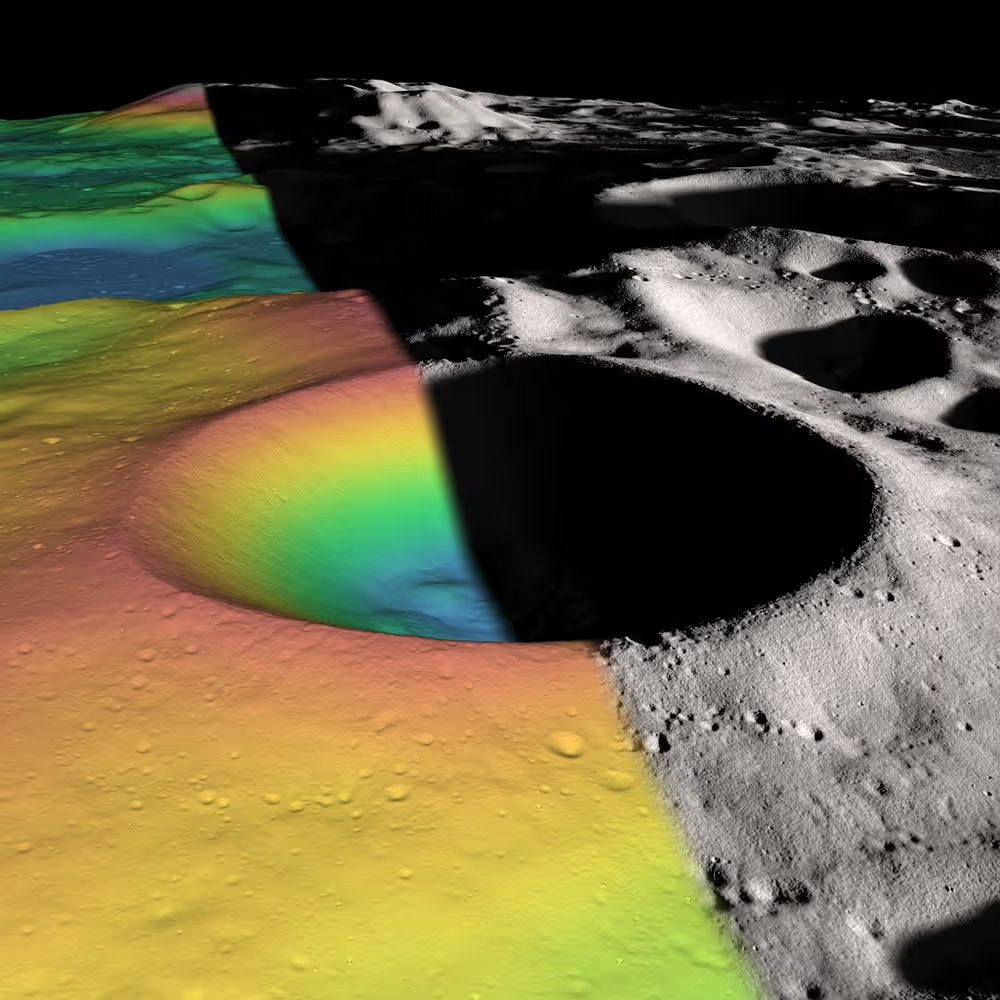 Shackleton Crater at the lunar South Pole, the leading site for early Moon Base infrastructure. Left: visible-light imagery. Right: color-coded elevation. Image credit: NASA.
What is genuinely new, and what is recycled
It is worth being plain about which parts of this plan are new and which are bits of older NASA programmes wearing fresh paint.
New: the architecture itself, with a continuously crewed surface base as the explicit endpoint rather than as a vague long-term aspiration. New: the cancellation of Gateway, which had become a sink for resources without a clear exploration return. New: the contracted, fixed-price rover and lander services with milestones tied to delivery rather than to design reviews. New: the MoonFall drone concept and the perimeter idea attached to it.
Recycled: Commercial Lunar Payload Services, which has been delivering small payloads since 2018 and is being scaled up into a 6 billion dollar, ten-year CLPS 2.0 procurement with a fifteen-year execution window. Recycled: the VIPER water-ice rover, which has survived several near-death experiences and is now one of the headline Phase One missions. Recycled: the Artemis crewed flights, including Artemis II's April 2026 lunar flyby and the Artemis IV surface landing now targeted for 2028 (a slip from the previous Artemis III plan). Recycled: the lunar communications and navigation constellation, which NASA had already been planning and has now been re-pointed to serve the base.
The honest unknowns
Half a century after Apollo, there is a great deal NASA does not know about the South Pole, and Isaacman acknowledged it.
"What we are embarking upon is extremely challenging," he said. "We know so little from what is a combined 80 hours of lunar astronaut EVA time across the Apollo missions, and that was more than a half century ago."
Soil mechanics in permanently shadowed regions are essentially unmeasured. The behaviour of jagged, electrostatically charged lunar dust around landers, rovers, suits and seals is still a research subject. Long-duration nuclear surface power on another world has never been operated. The Blue Moon Mark 2 crewed lander, the Lockheed-built Orion spacecraft, and the new Lunar Terrain Vehicles all have to come together on overlapping schedules. Budget forecasts are forecasts, not appropriations.
And there is the bigger question, the one Ars Technica's Eric Berger put to Garcia-Galan in his March interview: is this just Constellation, the George W. Bush-era Moon programme that was cancelled in 2010 after years of slipping schedules and ballooning costs, with new logos?
"We have to make it different," Garcia-Galan answered. "We can't do the same thing and expect a different result. I'm not focusing on fancy things to begin with. I'm focusing on how do we remove the blockers and chokeholds. Let's look at the supply chain. Let's hear from our vendors. Those are the brass tacks I'm going to be focusing on."
If the brass tacks hold, the four lights that the MoonFall drones leave shining at the corners of the Connecting Ridge will be the first persistent infrastructure humans have ever installed on the surface of another world.
Things You Might Not Know
| Fact | Detail |
|---|---|
| Where exactly | The leading site is the Shackleton Connecting Ridge, the high ground between Shackleton Crater and the de Gerlache Crater rim, roughly 89.9 degrees south latitude. |
| Why Gateway died | NASA could not justify the cost and complexity of an orbiting space station when every dollar it spent there did not advance surface operations. Garcia-Galan, who worked on Gateway, signed up to lead the cancellation. |
| Phase budget | Each of the three phases is forecast at around 10 billion dollars. Phase Three alone targets 28 landings per year and 38 tonnes of cargo annually. |
| The first lander | Blue Origin's Blue Moon Mark 1, an uncrewed cargo lander. Moon Base I, due to fly no earlier than fall 2026, will set down on the Shackleton Connecting Ridge. |
| MoonFall heritage | The drones are direct descendants of NASA's Ingenuity Mars helicopter. Where Ingenuity proved autonomous powered flight on Mars, MoonFall is doing the same with propulsion on the Moon. |
| The pressurised rover | JAXA is contributing a pressurised rover in Phase Two, an evolution of work Toyota and JAXA have been doing since 2019. It will let astronauts roam tens to hundreds of kilometres from base on multi-day traverses. |
| Survive the night | Lunar nights last roughly 14 Earth days and drop deep into cryogenic temperatures. NASA is paying performance bonuses to contractors whose hardware transmits after surviving a full lunar night, powered by radioisotope heater units. |
| The Connecting Ridge sunlight | Parts of the ridge see sunlight for more than 80 percent of the lunar year, making it one of the most solar-friendly patches of real estate on the Moon. |
| 1 cm per pixel | MoonFall's imaging target is a hundred times finer than current orbital coverage of most of the Moon, sharp enough to pick out individual rocks the size of golf balls. |
| The Artemis Accords | 67 nations have signed on as of May 2026. China and Russia have not, and are pursuing the rival International Lunar Research Station around the same South Pole region. |
Related Reading
- Artemis Programme overview the wider NASA crewed lunar effort that the Moon Base now anchors.
- Artemis III the first crewed surface landing, now redesignated and slipped to 2028 under the new architecture.
- Tracking the ISS: why its orbit, altitude and speed constantly change how orbital mechanics shape every crewed spaceflight, including the trajectories used to reach the Moon.
- Orbiting awkwardly: diplomacy on the Space Station the international cooperation model that is now being rebuilt for the surface of the Moon.
Sources: NASA's Moon Base reference page, the Moon Base development phases, NASA's May 26 news release on rovers, landers and missions, JPL's MoonFall mission page, the NASA Ignition event briefing materials, and contemporary reporting by Ars Technica's Eric Berger on the Ignition announcements, the interview with Carlos Garcia-Galan and the May 26 perimeter briefing.