

Five Things You Didn't Know About the International Space Station
The International Space Station has been quietly turning above everyone's head since November 1998. It is the most expensive single object humanity has ever built, the longest-running outpost of continuous human presence off the planet, and a workshop where the plumbing is more interesting than the experiments. Most people know it is up there. Far fewer know what it has been up to lately.
Here are five things about the ISS that even confident space fans tend to miss in 2026.
1. Continuous human presence has now cleared a quarter of a century
On 2 November 2000, William Shepherd, Yuri Gidzenko and Sergei Krikalev floated through the hatch of the Zvezda module and started the Expedition 1 mission. Nobody has left the station empty since. As of mid-May 2026 the unbroken human occupation stands at 25 years and roughly 200 days, the longest stretch of life off the surface of the Earth in our species' history.
That run quietly passed its silver anniversary on 2 November 2025. NASA marked it with a 2026 calendar, a "25 years on the ISS" feature, and a slightly larger-than-usual exhale of relief: the run has survived a Space Shuttle loss, two retirements of crew capsules, the COVID pandemic, a coolant leak on Soyuz MS-22 that stranded its crew for a year, and a war on Earth that almost cracked the partnership in half.
Expedition 74 is on board today. Roscosmos cosmonaut Sergey Kud-Sverchkov is in command, joined by Sergey Mikayev and NASA's Christopher Williams on Soyuz MS-28, and by SpaceX Crew-12: ESA's French astronaut Sophie Adenot, Roscosmos cosmonaut Andrey Fedyaev, and NASA's Jack Hathaway and Jessica Meir. Seven people, four agencies, three continents, one address.
The station moves underneath them at 7.66 km/s, or about 27,600 km/h (17,100 mph). It laps the Earth every 92.9 minutes, which gives the crew 16 sunrises and 16 sunsets in every working day. If you have ever wondered why astronauts use Coordinated Universal Time rather than a local clock: try arguing with a calendar that ticks over every 90 minutes.
2. The station now recycles 98 percent of the water on board
The ISS drinks its own sweat. It always has, in a sense, because moisture from crew breath and perspiration is pulled out of the cabin air and processed back into potable water. What changed in June 2023 is the percentage. The Environmental Control and Life Support System (ECLSS) confirmed it had hit a long-standing engineering goal: 98 percent of every drop of water sent up to the station is recovered and reused on board.
The number used to sit at 93 to 94 percent. The jump came from the Brine Processor Assembly (BPA), a small box of membranes and warm-air ducts that wrings the last few percentage points of water out of the residual brine left behind by the Urine Processor Assembly. "Let's say you collect 100 pounds of water on the station. You lose two pounds of that and the other 98 percent just keeps going around and around. Keeping that running is a pretty awesome achievement," Christopher Brown of the Johnson Space Center life-support team told NASA at the time.
There is a longer chain involved. Wastewater (humidity from the air, hygiene water, and urine) feeds into the Water Processor Assembly, which runs it through filters and a catalytic reactor that breaks down trace contaminants. Sensors check the result. Anything that fails reprocesses; anything that passes gets a small dose of iodine for microbial control and goes into the drinking tanks. Each crew member needs about a gallon of water a day for food, drink and hygiene, and almost all of it is the same water, over and over.
| Component | What it does | Why it matters |
|---|---|---|
| Water Processor Assembly | Filters and catalytically cleans collected wastewater | Produces the actual potable water |
| Urine Processor Assembly | Vacuum-distils urine into water and a residual brine | Recovered roughly 75 percent of the water in urine before the BPA |
| Brine Processor Assembly | Evaporates water out of the leftover brine | Pushed total water recovery from 93 to 98 percent |
| Humidity condenser | Pulls moisture from cabin air | About half of recovered water comes from crew breath and sweat |
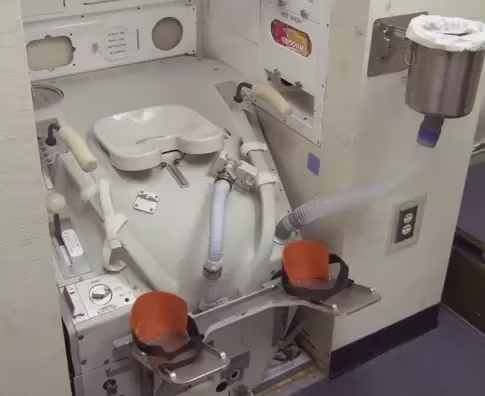 The waste and hygiene compartment in Zvezda. The station's three toilets, two American-style designs in Tranquility and Nauka and this Russian original, are the start of the ECLSS water loop. Image: NASA.
The reason this matters is not toilet humour. It is Mars. The longer NASA's life-support systems can run without resupply, the less mass needs to be flung out of Earth's gravity well to keep a crew alive on the way to anywhere interesting. As ECLSS water subsystems manager Jill Williamson put it, "The less water and oxygen we have to ship up, the more science that can be added to the launch vehicle."
3. SpaceX is building its retirement vehicle, and Congress is having second thoughts
The ISS has a retirement date. The current plan, signed off by all five partner agencies, is to operate the station to the end of 2030, then bring it down in a controlled re-entry in January 2031 over a remote patch of the South Pacific known as Point Nemo, the same spacecraft cemetery where most ISS cargo ships have been disposed of.
The vehicle that will do the deed is being built by SpaceX. In June 2024 NASA awarded the company a contract worth up to $843 million to build the U.S. Deorbit Vehicle (USDV): a heavily modified Cargo Dragon mated to a stretched trunk module packed with 46 Draco thrusters (rather than the usual 16) and around 30,000 kg of propellant, nearly six times what a standard Dragon carries. The USDV will launch in 2030 and dock at the Harmony forward port. It will then sit dormant for about a year while the station's orbit naturally decays from 400 km to roughly 220 km. When the time comes, the trunk will fire one or more orientation burns to drop the perigee to 150 km, then a final deorbit burn that ends 32 years and roughly 153,000 orbits of one of humanity's most stubborn building projects.
That is the plan on paper. Politics keeps editing the paper. In February 2025 Elon Musk, by then a Senior Advisor to President Trump, suggested the station should be deorbited "two years from now" rather than in 2031. In February 2026, a House Science Committee amendment by Congressman George Whitesides, with bipartisan support, asked NASA to study the feasibility of boosting the ISS to a higher "safe orbital harbor" so that future crews or commercial operators could one day refurbish it, instead of dropping the most expensive object ever built into the ocean. The amendment did not change the contract, but for the first time in years the ISS has a serious public argument about whether it has to die in 2031 at all.
Even if the USDV flies as planned, parts of the station may live on. Axiom Space's Payload Power Thermal Module is scheduled to dock to the ISS no earlier than 2027 and later detach to seed the free-flying Axiom Station. The Canadarm2 robotic arm is earmarked to continue its career on Axiom. And in late 2025 Roscosmos, under pressure on its budget, quietly revived plans to detach its newer modules (Nauka, Prichal, and a re-purposed NEM module not currently on orbit) to form the core of the Russian Orbital Service Station around 2030.
4. Six new roll-out blankets are quietly replacing its original solar wings
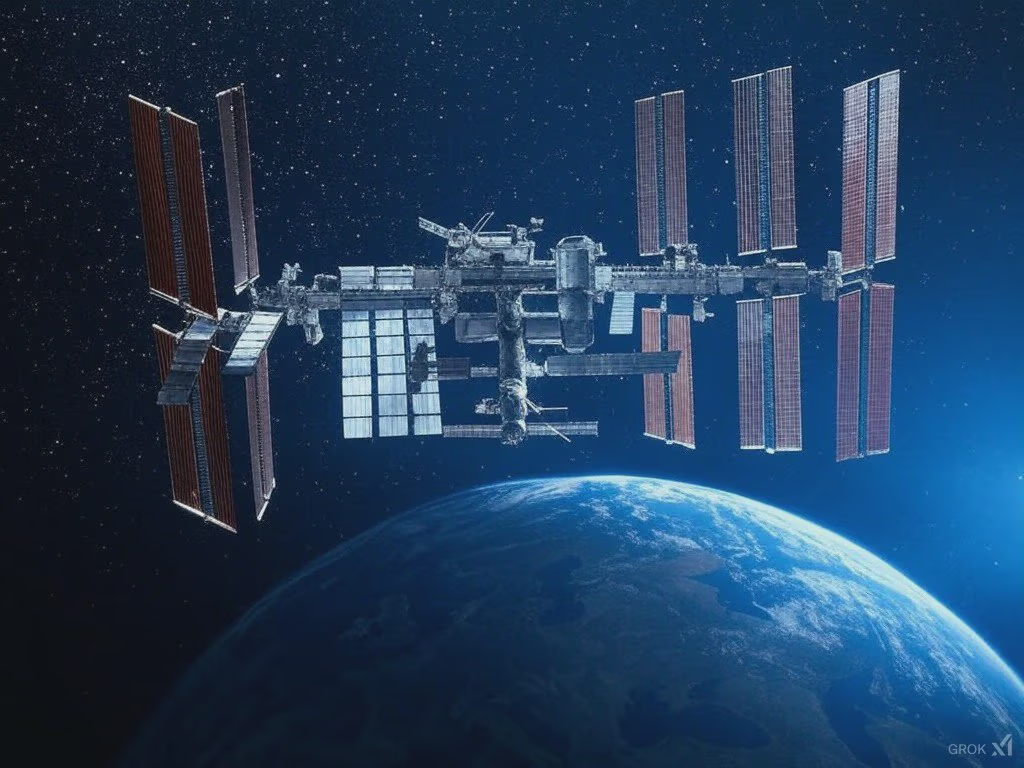
Look at any photograph of the ISS from the last three years and the giant solar wings stretching from the truss look subtly wrong: the symmetrical eight-pair pattern of the original arrays now carries six smaller, darker rectangles bolted across them like upgrade decals on an old car. Those are IROSAs, the ISS Roll-Out Solar Arrays, and they are the station's mid-life electrical refit.
The original USOS solar arrays, eight wings arranged as four pairs, were designed for a 15-year life. They were installed between 2000 and 2009. By the late 2010s their output was sliding in the way solar panels do: micrometeoroid pitting, ultraviolet damage, and steady electrical degradation had cost the station around a third of its original 75 to 90 kilowatt generating capacity. The fix, manufactured by Redwire (then Deployable Space Systems) and Boeing, was clever: each IROSA is a flexible photovoltaic blanket that rolls up like a yoga mat for launch in a Cargo Dragon trunk, then unfurls in orbit using stored mechanical energy in its composite booms. Each new wing covers about half of the older array beneath it, and because IROSAs use more modern, more efficient cells, the combined output exceeds the original new-build figures.
Six of the planned six IROSAs are now in service, installed on a series of spacewalks between June 2021 and June 2023. Together they restore the station's USOS power supply to roughly 120 kilowatts. That is enough to keep the Axiom commercial module powered when it arrives, and enough to run the dozens of new external payloads that have queued up for slots on Bartolomeo (on Columbus) and the ExPRESS Logistics Carriers.
The roll-up design itself is also a calculated bet on the future. The same architecture is the baseline for the solar arrays on NASA's Gateway lunar station and on several proposed commercial low-earth-orbit destinations. The ISS, in true ISS fashion, is the test bed for the technology it will not live long enough to see become the norm.
5. The crew has come from 26 countries, and the political map is shifting under their feet
As of August 2025, 290 individuals had visited the ISS according to NASA's official count, drawn from 26 different countries. By Wikipedia's mid-February 2026 tally, after SpaceX Crew-12 launched, the running total had reached 294. The United States accounts for 172 of them, Russia for 65, Japan for 11, Canada for 9. Italy, France and Germany sit in the middle of the table. Saudi Arabia, Sweden and the United Arab Emirates have each sent two. Belarus, Belgium, Brazil, Denmark, Hungary, India, Israel, Kazakhstan, Malaysia, the Netherlands, Poland, South Africa, South Korea, Spain, Turkey and the United Kingdom have each sent one. Tim Peake is still the only Briton in the list.
A growing share of those visitors are private citizens. Beginning with Dennis Tito in 2001, Roscosmos sold Soyuz seats to individual buyers for about $20 to $40 million each. Since 2022 the access pattern has shifted: NASA now approves Private Astronaut Missions (PAMs) on commercial vehicles, with Axiom Space flying four such missions on Crew Dragon between 2022 and 2024. Peggy Whitson, the former NASA chief astronaut, has commanded two of them and now holds the American record for time in space at over 675 days.
The geopolitical map underneath all of this is not stable. Russia has stated since 2022 that it intends to leave the ISS programme. The current commitment is for the Russian Orbital Segment to continue providing reboost thrust until 2028; thereafter Northrop Grumman's Cygnus spacecraft and the SpaceX USDV are the planned backstops. China has never been a partner: the 2011 Wolf Amendment bars NASA from bilateral cooperation with the China National Space Administration without explicit Congressional approval, which is why the Chinese Space Station orbits separately at a 41.5 degree inclination, with its own crew rotation entirely outside the ISS partnership.
For now, though, Sergey Kud-Sverchkov is commanding a station full of Americans, a Japanese flight engineer, a French ESA astronaut, two Roscosmos cosmonauts, and the daily quiet diplomacy of seven people sharing one circular kitchen 400 km above a fractious planet. That is still, quietly, the headline.
Things You Might Not Know
| Fact | Detail |
|---|---|
| The toilet is the start of the water cycle | Both US-segment toilets in Tranquility and Nauka, and the Russian original in Zvezda, feed urine directly into the Urine Processor Assembly. |
| There is no permanent crew kitchen | Meals are prepared with hot water dispensers and a small food warmer attached to a wall in Unity or Zvezda; the "dining room" is a folding table that velcroes wherever there is space. |
| Astronauts can grow tomatoes | The Veggie growth chamber in the Columbus and Kibo modules has produced lettuce, mizuna, radishes, zinnias, peppers, and in 2022 the first ISS-grown chilli pepper harvest. |
| The internet is faster than it used to be | A 2019 upgrade boosted the station's downlink via the TDRS network to about 600 Mbps, comparable to a decent home fibre connection. |
| Most laptops on board run Linux | The Portable Computer System laptops migrated from Windows XP to Debian Linux in 2013 for reliability, after a string of malware infections; the Station Support Computers still run Windows for productivity apps. |
| It is the most expensive single object ever built | Cumulative cost across all five partners is estimated at around $150 billion since 1985. |
| The thing you can see from your back garden is enormous | The full structure measures 109 metres (357 feet) end to end, with the solar truss spanning 73 metres (239 feet), wider than the wingspan of a Boeing 777. |
Watch It Yourself
The ISS is visible from 95 percent of the inhabited surface of the Earth and can pass nearly overhead, brighter than every star and most planets at magnitude minus four. issinfo.net can help with both ends of the curiosity gap:
- The live tracker shows where the station is right now, with altitude, speed and ground track updated in real time.
- The next pass tool tells you when the ISS will next be visible from wherever you are, weather permitting.
- The Who's in Space page lists the current crew, including their mission patches and biographies.
- The Artemis tracker follows the parallel programme NASA hopes will outlive the ISS at the Moon.
The station's lights are still on. It is worth looking up.
Related Reading
- Orbiting Awkwardly: Diplomacy on the Space Station on how the international partnership has held together through 25 years of terrestrial turmoil.
- Tracking the ISS: Why Its Orbit, Altitude and Speed Constantly Change on the orbital mechanics behind the numbers on the live tracker.
- Meet the Astrobees on the cube-shaped robot helpers that share the Kibo module with the human crew.
Sources: NASA's International Space Station hub, NASA Achieves Water Recovery Milestone on International Space Station, the NASA news release NASA Selects International Space Station US Deorbit Vehicle, Stephen Clark's Ars Technica coverage of the February 2026 storage amendment, Spaceflight Now's deorbit-vehicle update, and the Wikipedia articles on the International Space Station and the List of ISS expeditions.