

Orbiting Awkwardly: Diplomacy on the Space Station
A Spacecraft Emergency, Quietly
At about 16:34 UTC on 29 July 2021, NASA flight director Zebulon Scoville was running operations from Mission Control in Houston when the International Space Station began to roll. Russia's new Nauka science module had docked to Zvezda three hours earlier, and the crew were running leak checks before opening the hatches. Then, with no command from anyone aboard, Nauka's thrusters began to fire. The station rotated a full 540 degrees, one and a half complete turns, before the module ran out of propellant. Scoville did something he had not done in seven years as a flight director: he declared a spacecraft emergency.
The seven astronauts on board were never in danger, and the station was back to its original orientation within an hour. The post-incident commission, chaired by NASA administrator Bill Nelson with members from Roscosmos, ESA, JAXA and prime contractors on every side, traced the cause to a ground command sent before Nauka's Kurs rendezvous and TORU manual control systems had been deactivated. A software glitch. A misrouted instruction. And, for forty-five minutes, the closest humanity had ever come to losing the most expensive object ever built.
That is the texture of life on the International Space Station: a permanent diplomatic experiment dressed as a science laboratory, and a science laboratory that is also, frequently, a diplomatic experiment.
What the Station Is, and Whose It Is
The ISS first appeared in orbit on 20 November 1998, when a Proton rocket carried the Russian-built but US-funded Zarya module away from Baikonur Cosmodrome. Two weeks later, Space Shuttle Endeavour delivered the American Unity node and the two modules were mated. Continuous human occupation began on 2 November 2000 with the arrival of Expedition 1: cosmonaut Yuri Gidzenko, cosmonaut Sergei Krikalev and NASA astronaut Bill Shepherd, the first commander.
It is run by five partner agencies: NASA, Roscosmos, ESA, JAXA and the Canadian Space Agency. The hardware divides cleanly along that map. The Russian Orbital Segment, which includes Zvezda, Zarya, Poisk, Rassvet, Nauka and the Prichal docking node, is managed from Mission Control Moscow. The US Orbital Segment, which includes the American Destiny laboratory, the European Columbus laboratory, the Japanese Kibo, the Canadian Canadarm2 and a thicket of trusses and solar arrays, is run from Houston. The station weighs roughly 420 tonnes, spans about the length of a rugby pitch and orbits at an inclination of 51.64 degrees, around 400 km up, at 7.67 km per second. It circles Earth every 92.9 minutes. You can watch it do so on our live tracker.
As of August 2025, NASA records 290 individuals from 26 countries have visited the station. The current commander is Roscosmos cosmonaut Sergey Kud-Sverchkov; you can see who is currently on board and check when the station will next pass over your location. All five flags still fly on the patch.
Why It Was Built That Way
The political design predates the engineering. Through the late 1980s NASA was struggling to fund Space Station Freedom, which had been approved in 1984 but kept missing its budget targets. The Soviet Union was building Mir-2, modules of which were already on the floor at Khrunichev when the country collapsed in 1991. By 1993 both projects were dying. In September of that year US Vice-President Al Gore and Russian Prime Minister Viktor Chernomyrdin announced a merger: Freedom and Mir-2 would become a single station, and the shuttle would visit Mir in the meantime to learn how to fly with Russians. The first joint flight, STS-71, docked Atlantis to Mir in June 1995. The first ISS module followed three years later.
The 51.6 degree orbital inclination is a fossil of that compromise. Russian launches from Baikonur cannot easily reach lower inclinations without overflying inhabited parts of China or dropping spent stages over populated areas. The Americans would have preferred something close to 28 degrees, the latitude of Kennedy Space Center, but accepted the higher inclination so Soyuz and Progress could reach the station from Kazakhstan. The choice has paid back in unexpected ways. The ISS overflies 90 per cent of the inhabited Earth and is visible to far more of humanity than a lower orbit would allow.
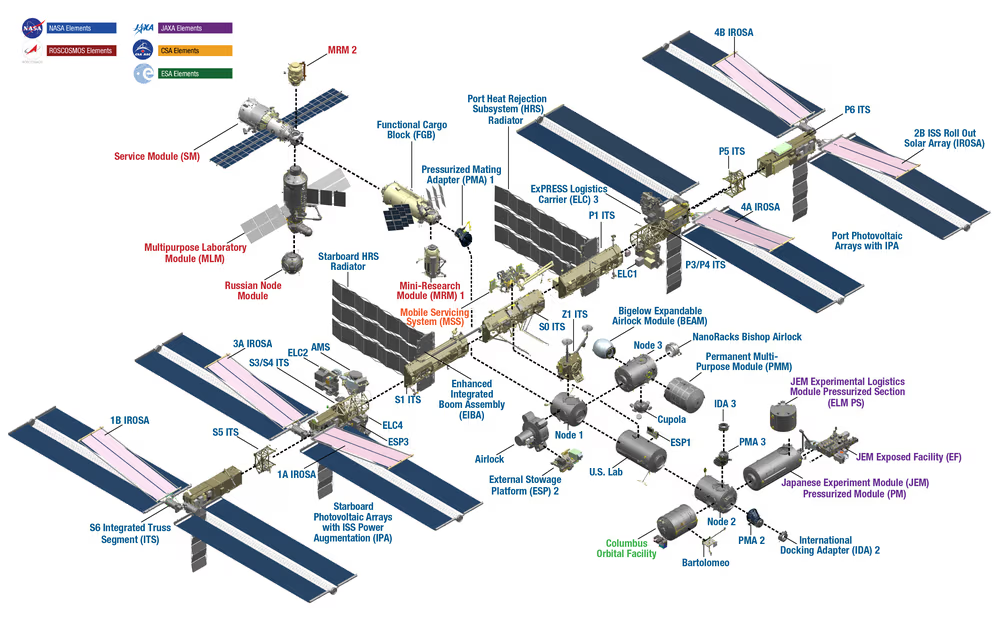 The station as a partition map. Russian modules sit on the aft end, the US Orbital Segment with European and Japanese laboratories extends forward, and the Integrated Truss carries solar arrays and radiators. Diagram credit: NASA.
Two Treaty Texts and One Refrigerator
The legal scaffolding is the 1998 Intergovernmental Agreement, signed in Washington by 15 governments, plus a stack of bilateral Memoranda of Understanding between NASA and each partner agency. Article 5 grants each partner jurisdiction over its own registered modules in the way a country has jurisdiction over a registered ship. A cosmonaut floating into Destiny is a guest abroad; a NASA astronaut sleeping in Nauka is in Russian territory.
That sounds tidy until the food refrigerator breaks down. The MoUs also divide everything that is not territory: crew time, electrical power, video bandwidth, gym slots and Wi-Fi. The split is roughly 76 per cent of USOS resources to NASA, 12.8 per cent to JAXA, 8.3 per cent to ESA and 2.3 per cent to CSA, with the Russian segment run independently by Roscosmos. The shared toilets, all three to Russian design, are an institution: NASA paid Roscosmos around $19 million in 2019 for an updated Universal Waste Management System for the Tranquility module.
2014: The First Cold-Vacuum Stare
The annexation of Crimea in March 2014 was the first serious test of the post-Cold-War arrangement. The Obama administration suspended most NASA contacts with Russian officials within weeks. Roscosmos chief Dmitry Rogozin, whose previous brief had been deputy prime minister overseeing the defence industry, joked on Twitter that the United States should "deliver its astronauts to the ISS using a trampoline". The station, however, was carved out of the freeze. A NASA memo specifically excluded ISS operations from the suspension.
The reason was simple. The Space Shuttle had been retired in 2011 and SpaceX Crew Dragon would not fly its first crewed mission until May 2020. Every NASA astronaut on the station reached orbit in a Soyuz launched from Baikonur, and every American crew rotation that year cost NASA between $70 million and $80 million per seat, paid to Roscosmos. The cooperation was, in a phrase NASA officials would not say out loud, contractually mandatory. By the time SpaceX's Demo-2 carried Bob Behnken and Doug Hurley to the station, the political weather had shifted again. Rogozin lost the Roscosmos job in 2022.
July 2021: The Roll
Nauka arrived eight years late and weighed 20,357 kg. It had been built in the 1990s as a backup to Zarya, set aside at 70 per cent completion, then rescued for a second life as the Multipurpose Laboratory Module. Fuel-tank contamination, valve leaks and the pandemic delayed it from 2007 to 2021. After launch on 21 July 2021, problems with telemetry and the main propulsion system forced engineers in Korolyov to nurse it through a week of orbit-correction burns before it could rendezvous.
When it docked to Zvezda's nadir port on 29 July, the relief inside Mission Control Moscow was visible. Then the stray ground command. Controllers tried to counteract the rotation using Zvezda's engines and then Progress MS-17, docked to Pirs. The roll only stopped when Nauka burned through its remaining propellant. NASA delayed Boeing's Starliner Orbital Flight Test 2, scheduled to launch days later, by 96 hours.
There was no public anger from either agency. The crew opened the hatches into Nauka the next day and outfitted the module across twelve spacewalks over two years. The European Robotic Arm, riding on Nauka's exterior, came to life in 2022. The science airlock was berthed in May 2023. Nauka now hosts experiments, additional sleeping quarters and the only large observation window on the Russian segment.
December 2022: Stream of Flakes
At 12:45 UTC on 15 December 2022, cameras caught a steady plume of white particles drifting away from Soyuz MS-22. A scheduled Russian spacewalk by Sergey Prokopyev and Dmitry Petelin was cancelled while controllers worked out what was happening.
The plume was coolant. A micrometeoroid had punched an 0.8 mm hole in the external radiator of MS-22's service module, draining the loop that kept the spacecraft's electronics and cabin temperatures liveable. Inside the orbital and descent modules the temperature drifted up to about 30 degrees C. In the service module it reached 40. By January 2023 it had stabilised around 30 degrees throughout, uncomfortable for a long flight but not lethal.
The real problem was that MS-22 was the only way home for Prokopyev, Petelin and NASA astronaut Francisco Rubio. Roscosmos and NASA opened parallel contingency tracks. An empty Soyuz, MS-23, was prepared for an emergency launch. In the meantime, on 17 January 2023, NASA moved Rubio's seat liner from MS-22 into Crew Dragon Endurance, docked at Harmony. It was the first time a Soyuz seat liner had ever been transferred to an American spacecraft. With Rubio added to Crew-5's normal four, Endurance could serve as his lifeboat if MS-22 had to be abandoned. Prokopyev and Petelin remained assigned to the leaking Soyuz; if they had to bail out, they would do so in temperatures the original Russian designers had hoped never to test.
Soyuz MS-23 launched uncrewed on 24 February 2023 and docked two days later. The original MS-22, with 218 kg of dry cargo on board but no people, undocked on 28 March 2023 and landed safely in Kazakhstan, the second uncrewed Soyuz return in history after Soyuz 32 in 1979. Prokopyev, Petelin and Rubio came home on MS-23 in September 2023. Rubio's accidental 371-day stay set a new American spaceflight endurance record.
A nearly identical leak on Progress MS-21 in February 2023, and a third on Nauka's RTOd external radiator in October 2023, suggested either a run of bad luck or a hardware family with a quiet design weakness. Roscosmos has not publicly settled the question.
What Russia Said It Would Do, and What It Has Done
On 26 July 2022, five months after the Russian invasion of Ukraine and during a particularly bleak stretch of partnership news, the new head of Roscosmos, Yury Borisov, told President Putin that Russia would withdraw from the ISS programme "after 2024" and concentrate on a national orbital station. By the next day Roscosmos was clarifying: Russia would stay until at least 2028, and the Russian Orbital Service Station would be assembled in parallel rather than instead. In late 2025 Roscosmos confirmed plans to detach Nauka along with Prichal, replace Prichal with a near-identical Universal Node Module around 2028, and use the assembly as the core of the new station. NEM, the long-delayed Science Power Module, is now expected to launch in 2029. After the modules separate around 2030, Nauka will outlive the ISS itself.
The Russian segment is not optional in the meantime. Orbit-keeping reboost burns are normally performed by Zvezda's main engines or by Russian and European cargo spacecraft docked to its aft port. Without that thrust the station would lose around 2 km of altitude per month to atmospheric drag. Northrop Grumman demonstrated a Cygnus reboost in 2022, and SpaceX has tested a Cargo Dragon reboost since, but the existing infrastructure runs on Russian propellant. Both sides know this, and both sides know the other side knows.
The Wolf Amendment and the Chair China Was Not Offered
China is not an ISS partner. The reason is a single paragraph of US law. In April 2011 Representative Frank Wolf of Virginia attached language to Public Law 112-10 forbidding NASA and the Office of Science and Technology Policy from using federal funds to "develop, design, plan, promulgate, implement, or execute" any bilateral programme with China or Chinese-owned entities without specific congressional authorisation. The same paragraph banned NASA from hosting Chinese government visitors at its facilities. The clause, now universally called the Wolf Amendment, has been renewed every year since.
The Amendment did not formally evict China from the partnership, because China had never formally been invited in. The practical effect is the same. China's Tiangong space station now orbits at an inclination of 41.47 degrees, lower and more equatorial than the ISS, served by its own Shenzhou crewed and Tianzhou cargo spacecraft. It has been continuously occupied since June 2022, around one-fifth the mass of the ISS but with similar autonomy and crew complement.
Defenders argue the Amendment limits the leak of dual-use technology to the People's Liberation Army, which oversees China's human-spaceflight programme. Critics, including the Center for Strategic and International Studies and the Harvard International Review, argue it has produced exactly the parallel Chinese capability it was meant to prevent. When China returned the first samples from the far side of the Moon on Chang'e 6 in June 2024, US researchers were largely barred from analysing them without prior FBI certification, despite an explicit CNSA offer.
The result aboard the ISS is a station with three permanent windows on geopolitics: a Russian segment whose budget is voted in Moscow, a Western segment whose research priorities run through Washington, Paris, Tokyo and Ottawa, and a missing Chinese segment whose absence is enforced by US appropriations law. Tiangong tracks across the same skies; both stations can be picked out from your next pass page, usually a few thousand kilometres and a few minutes apart.
Hardware, Crew and the Small Things That Hold
What is striking, given all that, is how little of the friction reaches the crew. Astronauts who have shared the station's 388 cubic metres of habitable volume for six months tend to report two things. The first is that the working relationships across the hatch are warmer than the relationships across the agencies on the ground. The second is that you have to be careful what you say about that on the record.
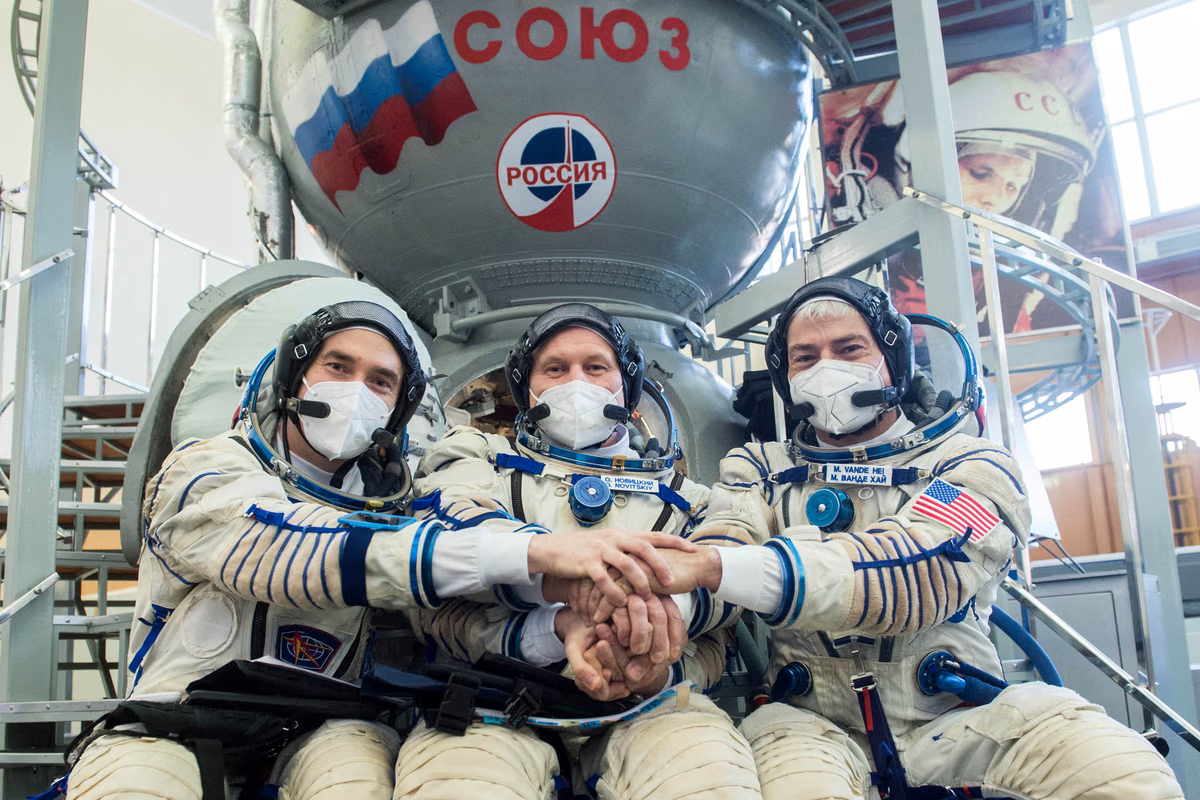
On 11 March 2022, two weeks into the invasion of Ukraine, returning cosmonauts Anton Shkaplerov, Oleg Artemyev and Pyotr Dubrov landed in Kazakhstan in Soyuz MS-19 wearing yellow and blue flight suits. Roscosmos insisted the colours were those of Bauman Moscow State Technical University. NASA astronaut Mark Vande Hei flew home in the same capsule.
Anti-satellite weapons are a separate story. On 15 November 2021 the Russian military destroyed the defunct Kosmos 1408 satellite with a direct-ascent missile from Plesetsk. The test created at least 1,500 trackable fragments, several of which passed close enough to the ISS that the crew, including two Russians, sheltered in their docked spacecraft. NASA administrator Bill Nelson called it "unthinkable that Russia would endanger" the lives of cosmonauts on the station. Both statements were addressed to different audiences.
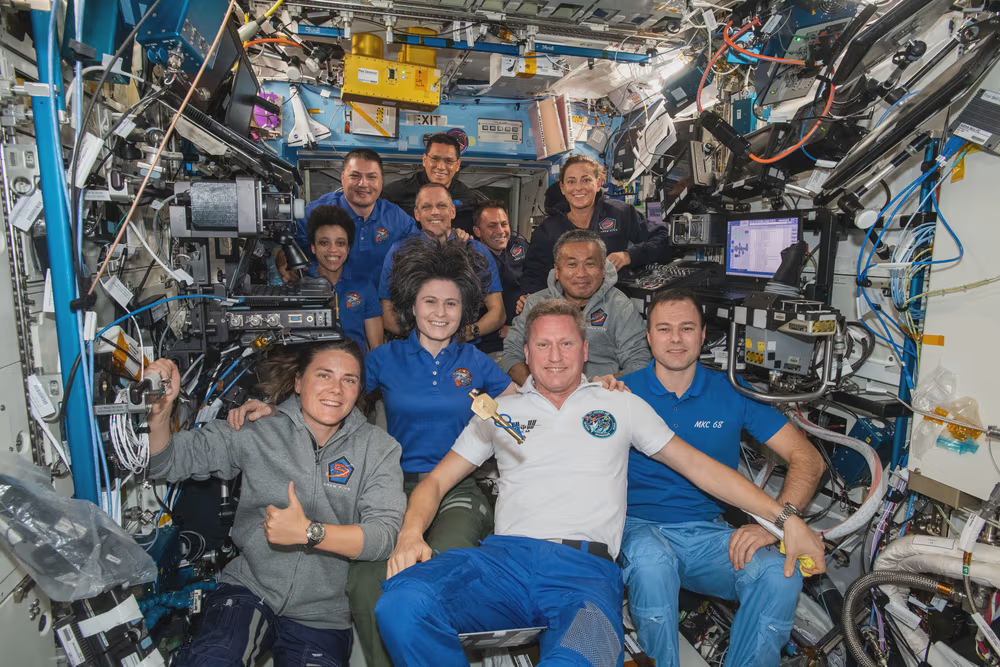 Expedition 68, photographed in 2022, with the symbolic command key floating between Samantha Cristoforetti of ESA and incoming commander Sergey Prokopyev of Roscosmos. Front: cosmonauts Anna Kikina, Sergey Prokopyev, Dmitri Petelin. Middle: Cristoforetti and Koichi Wakata of JAXA. Back: NASA astronauts Jessica Watkins, Kjell Lindgren, Bob Hines, Frank Rubio, Josh Cassada and Nicole Mann. NASA image.
The Numbers That Pay for All of This
NASA reports its ISS operating budget at about $3 billion per year. Through 2010 the cumulative cost was $150 billion, split as NASA $58.7 billion, Russia $12 billion, Europe $5 billion, Japan $5 billion, Canada $2 billion, plus 36 Space Shuttle assembly flights at roughly $1.4 billion each. The years since lift the total well past $200 billion in 2024 dollars. The station-keeping fuel alone, just under 7.5 tonnes a year, costs about $210 million.
That money has bought more than 3,000 experiments from researchers in over 100 countries, including the Alpha Magnetic Spectrometer recording cosmic-ray data since 2011, the NICER X-ray telescope near Kibo, and the Cold Atom Lab. There is no obvious second laboratory of this kind on the horizon, though robotic helpers like the Astrobees hint at how successor stations might run with less crew supervision.
The recurring political question is whether to keep paying. The Space Frontier Act of 2018, the Leading Human Spaceflight Act, and the CHIPS and Science Act of 2022 each authorised ISS operations through 2030. In February 2026 the House Committee on Science, Space and Technology introduced a bipartisan amendment requiring NASA to study lifting the station to a higher "storage" orbit at end of life rather than destroying it.
The Cargo Dragon That Brings the Station Down
NASA's current plan, if Congress does not change it, is to deorbit the ISS in January 2031. In June 2024 NASA awarded SpaceX a contract worth up to $843 million to build the US Deorbit Vehicle. The USDV will be a Cargo Dragon mated to a stretched trunk module fitted with 46 Draco thrusters (a standard Cargo Dragon has 16) and 30,000 kg of propellant, roughly six times the normal load. It launches in 2030 and docks at the forward port of Harmony, then sits dormant for about a year as the orbit decays from 400 km to around 220 km. The USDV then performs one or two orientation burns to lower the perigee to about 150 km. The final deorbit burn drops the station into the atmosphere over the South Pacific, targeting the spacecraft cemetery near Point Nemo. The Russian modules will not all come down with the rest: current plans call for the future ROS modules including Nauka to be undocked shortly before the deorbit burn and reformed into the seed of the new Russian station.
On 20 February 2025 Elon Musk, then both CEO of SpaceX and a senior advisor to President Trump, suggested on his social network that the ISS should be deorbited "as soon as possible", perhaps "two years from now". No partner agency has endorsed the proposal; no formal change has been made to the 2031 plan. SpaceX is, however, the prime contractor for the vehicle that would do the job.
What Replaces It, If Anything Does
NASA's Commercial LEO Destinations Program is the planned successor. Three stations are in development: Axiom Station, the Voyager Space-led Starlab, and the Orbital Reef proposal from Blue Origin and Sierra Space. Axiom is furthest along. Its Payload Power Thermal Module is scheduled to dock at the ISS no earlier than 2027, followed about a year later by a habitat module, after which Axiom intends to detach and operate independently, taking Canadarm2 with it. NASA's minimum condition for the 2031 deorbit is that the USDV is ready and at least one commercial station is operational. The orbital mechanics will not wait.
Lunar Footnote
The diplomatic patterns laid down on the ISS will outlive the station. The Artemis Accords, signed by more than 50 nations by early 2026, are the successor framework in cis-lunar space, and Russia and China have not signed. The Lunar Gateway, under construction with NASA, ESA, JAXA, CSA and the UAE as partners, will function as a smaller, harsher ISS in a halo orbit around the Moon. Artemis II is scheduled to fly a free-return trajectory in 2026, with the planned Artemis III landing flight following it; both can be followed through the Artemis tracker. Russia and China are jointly planning the International Lunar Research Station, a parallel architecture that the Wolf Amendment forbids the United States from joining.
None of that was anticipated by the 1998 Memorandum of Understanding. What happened instead is more interesting: a station continuously occupied by international crews for more than 25 years, despite Crimea, Ukraine, Tiangong and the trampoline tweet, in part because nobody could afford to be the one who broke it. The orbit itself will remain a 51.6 degree compromise between Florida and Kazakhstan, an arc that passes over most of the people watching it. The floor plan was drawn in 1993, and the lessons of the next thirty years will be the lessons of how people get along inside a pressure shell that nobody can leave easily.
Related Reading
- Five Things You Didn't Know About the International Space Station for the orbital trivia that makes the day-to-day diplomacy easier to picture.
- Tracking the ISS: Why Its Orbit, Altitude and Speed Constantly Change for the physics behind the 51.6 degree compromise.
- Meet the Astrobees for a closer look at the on-board robotics that may eventually let the station, and its successors, run with less crew time.
Sources: NASA's International Space Station and US Deorbit Vehicle pages, Wikipedia's articles on the International Space Station, Nauka and Soyuz MS-22, Kenneth Chang's New York Times account of the Nauka roll, Jeff Foust's SpaceNews coverage of Russia's 2028 commitment and the Musk deorbit comments, and the Wolf Amendment text in Public Law 112-10.