

Meet the Astrobees: NASA's Free-Flying Robot Bees on the Space Station
A First Day on the Job
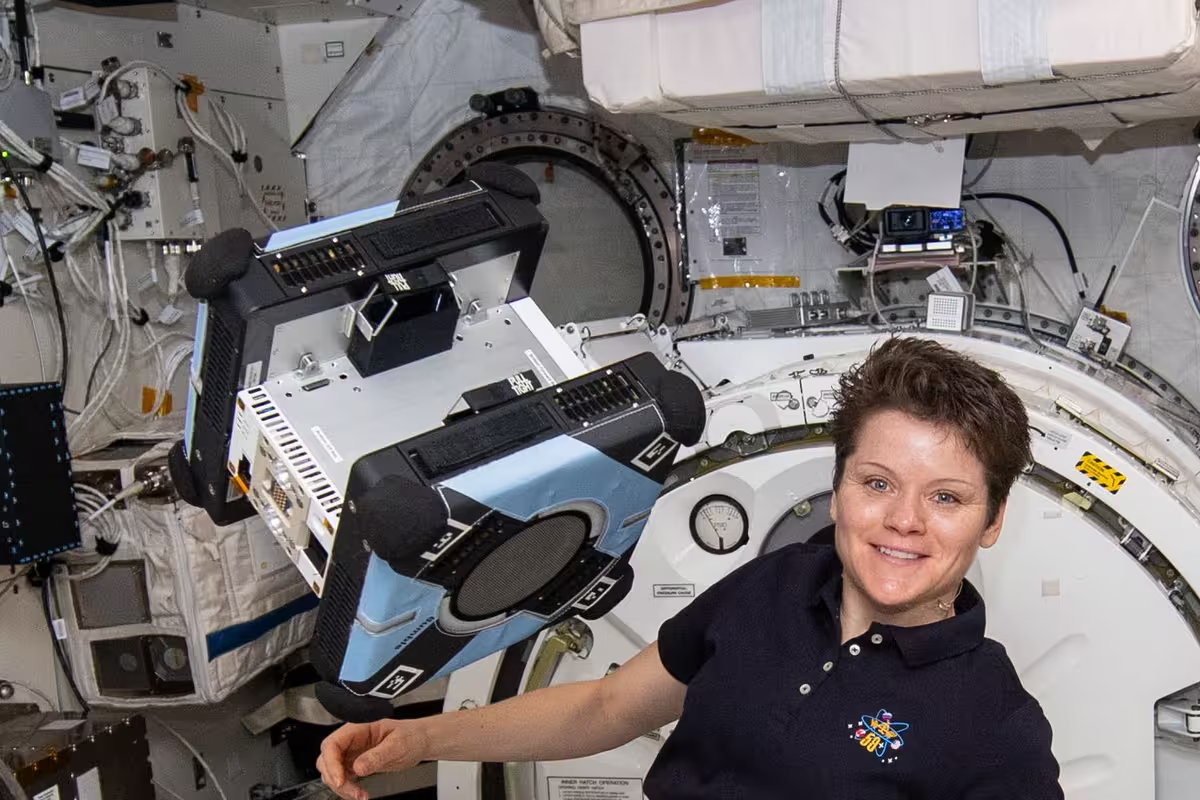
On April 30, 2019, NASA astronaut Anne McClain floated into the Japanese Kibo module of the International Space Station and unzipped a soft white bag. Inside was a cube about the size of a toaster, wrapped in soft black bumpers, with a cluster of camera lenses on one face. Its name was Bumble, and it was the first Astrobee.
McClain steadied it in mid air and began swapping commands with a team waiting 400 km below at NASA's Ames Research Center in California's Silicon Valley. Subsystems checked. Fans spinning. Cameras taking their first interior portraits of a space station. Six weeks later, on June 14, 2019, Canadian Space Agency astronaut David Saint-Jacques guided Bumble through Kibo for its first powered flight, letting the robot calibrate its navigation by watching the module slide past its cameras.
That quiet "yes, it's working" moment was the start of something bigger: the first time a flying robot would live full time on the station as a teammate rather than a one off experiment. Bumble and its two siblings, Honey and Queen, have since logged more than 1,200 hours of operations and supported over 150 investigations, from gecko inspired grippers to satellite rendezvous algorithms. This is the story of three space bees, the Star Wars film that started the family tree, and why NASA thinks they are a preview of how humans and robots will work together far beyond Earth.
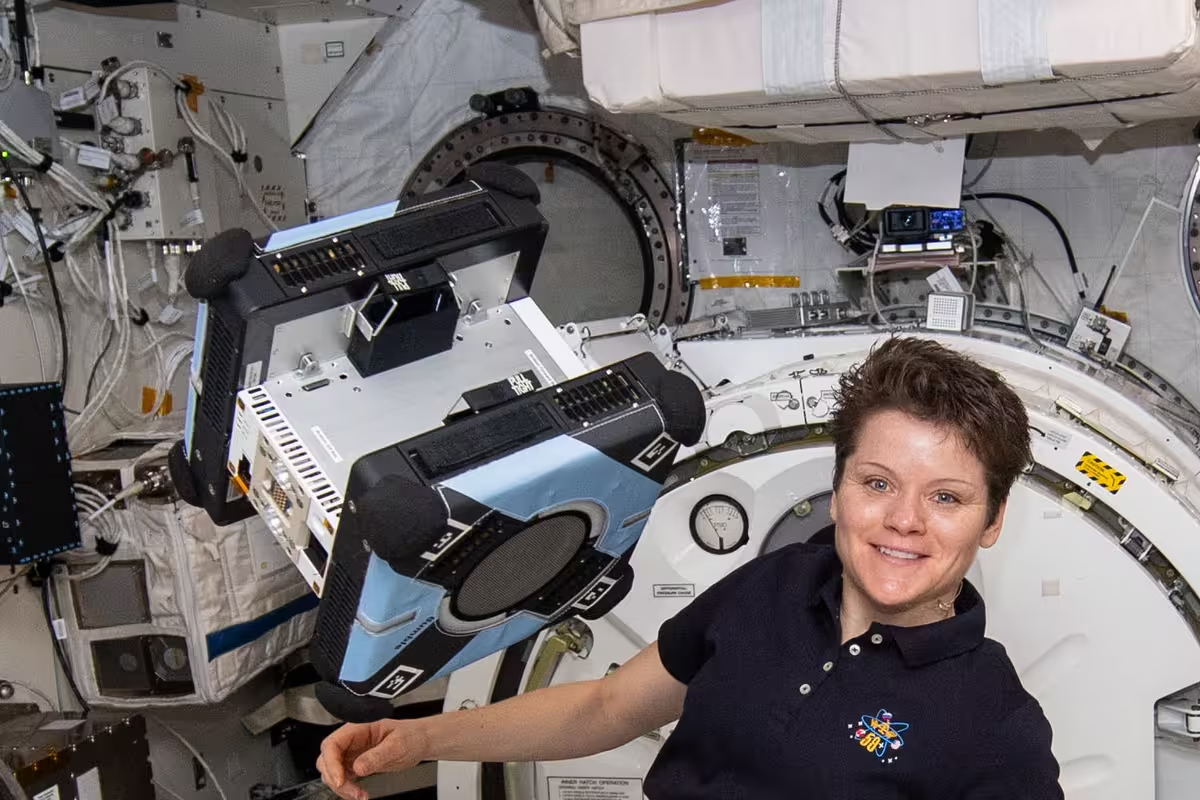 Anne McClain with the first Astrobee, Bumble, in the Kibo module on April 30, 2019. NASA / Anne McClain.
Why Bring Robots Up There in the First Place?
Life aboard the ISS is timetabled to the minute. Science experiments, hardware swaps, two hours of exercise to stop human muscles wasting away, video calls with classrooms, plus the universal chore of finding the cargo bag that was definitely put down "right here" last Tuesday. Astronauts are the most expensive humans above sea level. Every hour they spend hunting for a Velcro tool kit is an hour not spent on science.
NASA's Astrobee team at Ames set out to fix that. The pitch was simple: build a small autonomous robot that could buzz through the station on its own, scan barcodes on cargo bags, read sensors, snap photos for ground controllers, and quietly tidy up the housekeeping that eats into crew time. Done well, it would save astronaut hours. Done very well, it would also be a free flying laboratory for guest scientists who wanted to try ideas in microgravity without launching their own satellite.
The team already had form for this kind of thing. Since 2006 they had been running an MIT born experiment called SPHERES, short for Synchronized Position Hold, Engage, Reorient, Experimental Satellites: three softball sized, eighteen sided polyhedrons that floated around the station using puffs of pressurised carbon dioxide. The SPHERES units ran for more than a decade and supported close to 600 experiments. But they were ageing, ran through their gas cartridges quickly, and could only operate while an astronaut was babysitting them.
Astrobee was designed as the grown up successor. More autonomy, more cameras, more compute, and a propulsion system that does not run out of fuel.
The Star Wars Heritage
Now and then a NASA programme cheerfully admits where it borrowed its inspiration. The Astrobee family lineage starts with one of cinema's most quoted scenes.
In the late 1990s, MIT professor David Miller showed his senior design class the moment from the first Star Wars film when Luke Skywalker spars with a small floating training remote aboard the Millennium Falcon. Miller told the class, in essence, "I want you to build me this." His students did, with funding from the Defense Advanced Research Projects Agency. Their three robots became SPHERES, and they launched to the ISS in 2006. When SPHERES retired in 2019, Astrobee inherited the bloodline. Different shape, different propulsion, much more autonomy, but the same animating idea that a small free flying robot is a useful teammate inside a spacecraft.
Astrobee does not zap anyone. It does the same trick of hovering steadily in a confined space, smoothly changing direction, and treating gravity as a polite suggestion.
What an Astrobee Actually Looks Like
Picture a cube about 12.5 inches (32 cm) on each side, wrapped in soft black bumpers so it never scratches a panel or bonks an astronaut on the head. Two faces are full of vents. Another carries a small touchscreen "face" with two blue eyes that light up when the robot is active. A folding arm tucks underneath, ready to reach out and grip a station handrail like a tiny gymnast.
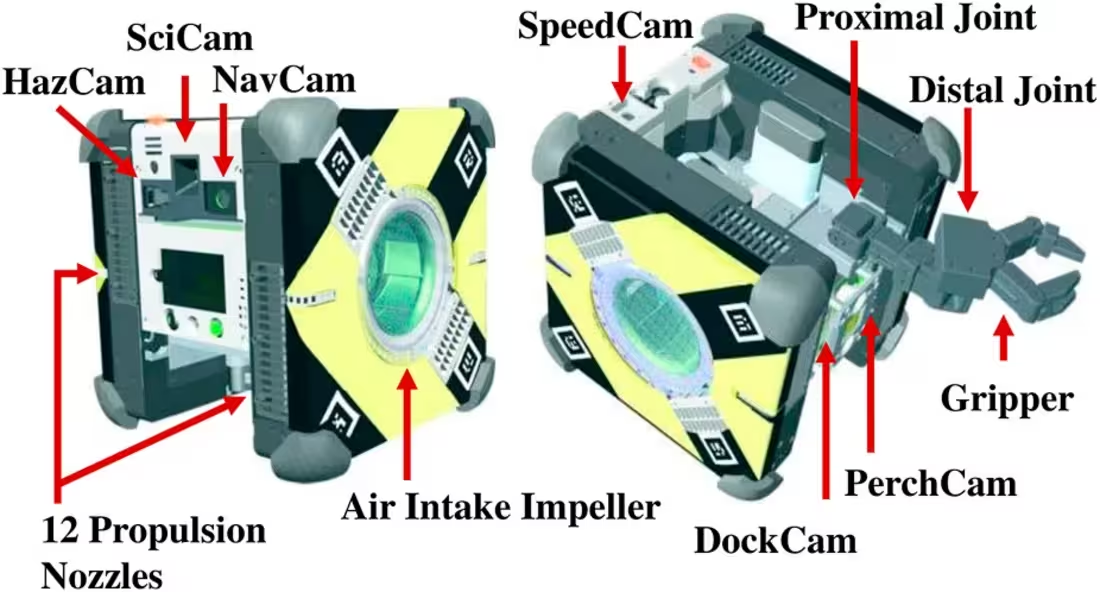 Anatomy of an Astrobee, annotated by researchers in the Frontiers in Robotics and AI paper by Park, Albee and others. The free flyer is a roughly 30 cm cube with cameras, an impeller based propulsion module and a small perching arm.
Inside the bumpers is where things get clever. Astrobee does not fly on rocket fuel, and certainly not on compressed gas. Instead, it has two electric impellers behind protective grilles. They counter rotate at high speed, which cancels out the gyroscopic forces that would otherwise spin the robot in circles. The impellers do not actually push Astrobee anywhere. Their job is to pressurise the inside of the cube with a constant cushion of air.
The pushing comes from twelve steerable nozzles arranged around the body. When a nozzle opens, air shoots out, and Astrobee scoots away from it. Open the right combination and the robot can translate, rotate or hold position with surprising precision. Close them all and it just hangs in the middle of the module like a magician's lit up box.
When the battery starts to dip, Astrobee finds its docking station inside Kibo and snuggles in to recharge. When the day's science is over, the perching arm grabs a handrail so the robot does not drift while it sleeps. It is a strangely cosy picture: a small black cube clinging to the wall of a space lab, eyes dimmed, waiting for the next shift to begin.
There is also a hardware safety net the engineering manuals are proud of. Each Astrobee carries a physical Terminate Button on its body. A single press cuts power to the propulsion and any guest payload while keeping the main processors alive so the robot can still talk to the ground. It is the most direct kind of off switch on the station: any crew member who is not happy with what a bee is doing can simply press it.
Spec sheet
| Property | Value |
|---|---|
| Shape | Cube |
| Edge length | 12.5 inches (about 32 cm) |
| Propulsion | Two counter rotating electric impellers feeding 12 steerable nozzles |
| Power | Rechargeable battery, returns to dock when low |
| Sensors | Multiple cameras, microphone, laser pointer, lights |
| Compute | Onboard processors running flight software based on the Robot Operating System (ROS), upgradable in orbit |
| Manipulation | Folding perching arm with gripper that grasps standard station handrails |
| Safety | Physical "Terminate Button" that shuts down propulsion while keeping comms alive |
| Operating environment | Inside the pressurised modules of the ISS, primarily Kibo |
| Home base | Astrobee docking station in the Japanese Experiment Module |
Meet the Hive
There are three Astrobees on orbit. Each has a name, a colour and a launch story.
| Robot | Colour | Launched on | From | Date |
|---|---|---|---|---|
| Bumble | Blue | Northrop Grumman CRS-11 (Cygnus) | Wallops Flight Facility, Virginia | 17 April 2019 |
| Honey | Yellow | Northrop Grumman CRS-11 (Cygnus) | Wallops Flight Facility, Virginia | 17 April 2019 |
| Queen | Green | SpaceX CRS-18 (Dragon) | Cape Canaveral, Florida | 25 July 2019 |
Bumble was the first to wake up, the one Anne McClain unpacked on that April afternoon in 2019. Honey rode along on the same Cygnus and got its own "Hi Honey!" boot up later that summer. Queen followed three months later on a Dragon out of Cape Canaveral. NASA's announcement of Queen's first power on, titled with full enthusiasm "Oh, Hiiiiive! Astrobee Queen Wakes Up In Orbit", set the tone for the whole programme.
Read the engineering documents and a few more bee themed names crop up: Wanna Bee, Bee Sharp and Killer Bee. Those are the Earth bound siblings, kept at Ames so engineers can break, fix and reprogram them on the ground before any change is uploaded to the flight units. Killer Bee is sometimes wheeled onto an air bearing table that lets it slide almost frictionlessly across a polished granite slab, mimicking the feel of weightlessness one floor at a time.
The docking station itself launched separately, on Northrop Grumman's 10th cargo mission in November 2018, and was bolted into Kibo on 15 February 2019. Everything had to be in place before the first bee could buzz.
What the Bees Actually Do
This is where Astrobee earns its electricity.
Camera work. Each Astrobee carries multiple cameras and a microphone, so it can act as a remote controlled scout for engineers on the ground. If a flight controller in Houston wants to check whether a panel is properly latched in Harmony, they can wake a bee, fly it over and look. No astronaut needs to interrupt what they are doing.
Inventory. A station full of bags and bins is a station full of barcodes. Astrobee can scan them, log them and update the cargo database, all while the crew is asleep.
Guest science. This was the headline promise of the programme and it has been delivered. Universities, research labs and high school teams have written software that controls the Astrobees for short experimental runs. As of 2024 the facility had supported more than 150 investigations and clocked over 1,200 operational hours, many of them sponsored by the ISS National Laboratory.
STEM education. MIT's Zero Robotics competition, which used to run on SPHERES, switched to Astrobee around 2022. Students write code on the ground, it is uploaded to the bees on station, and the final rounds run live in orbit with hundreds of children watching their software fly.
Autonomous milestones. Two and a half years after Bumble's first powered flight, on 7 April 2022, NASA pushed the platform a step further: Bumble and Queen worked at the same time in separate modules with no astronaut in the room. Bumble mapped Harmony. Queen captured the first 360 degree panoramic image of the orbiting lab from the inside. NASA called it a milestone in human and robot teamwork, and rightly so.
If you want to see an Astrobee in flight, NASA's overview video on YouTube is a friendly two and a half minutes that walks through the design, the mission and a few clips of the real hardware spinning up in orbit.
Greatest Hits in the Guest Science Programme
A handful of investigations have become the bees' signature party pieces.
Gecko Gripper. Stanford University built grippers based on the microscopic flexible spikes that let geckos cling to walls. In May 2021 NASA astronaut Victor Glover used Honey to test them, fitting the robot with pads that engage and release on tilt, the same trick a gecko uses. In zero gravity an Astrobee could grab and release smooth flat surfaces, like the side of a docked cargo capsule, without glue or magnets. The implication is large: future repair robots could perch on the outside of a spacecraft without bolts, hooks or velcro.
SoundSee. Bosch and Pittsburgh based aerospace firm Astrobotic built a smart microphone array called SoundSee, attached it to an Astrobee, and used machine learning to listen for early warning signs of equipment trouble. The idea is that pumps, fans and HVAC kit on the station all "talk" through vibration, and a flying microphone that learns those voices can diagnose anomalies before they become breakdowns. The demonstration worked.
ROAM and ReSWARM. MIT roboticist Keenan Albee led a project called Relative Operations for Autonomous Maneuvers, in which one Astrobee acted as a tumbling target satellite and another as a chaser. The chaser used its onboard cameras to model the target's tumble and then planned a successful rendezvous with it. A follow on, ReSWARM, scaled the idea up to multiple satellites assembling structures in orbit. Both campaigns also fed back improvements into the Astrobee software the rest of the programme uses.
ISAAC. The Integrated System for Autonomous and Adaptive Caretaking is NASA's flagship use of the bees as test subjects. In April 2021 Bumble worked through a simulated emergency: a high carbon dioxide reading was reported, the robot flew off, found a "vent" with a printed sock taped over it as the foreign object, identified the blockage by computer vision and called for help. Later test phases added cargo transfers between an uncrewed station and an uncrewed visiting cargo ship, and increasingly nasty simulated faults like mock cabin leaks. Trey Smith, the ISAAC project manager at Ames, put the long view simply: "Our long-term vision is that it can transform a spacecraft into an autonomous robotic system itself."
The Hop
One of the cleverest tricks Astrobee has been used for is called the hop. It blends the perching arm and the propulsion nozzles into one tidy manoeuvre, and it has been studied in detail at Ames.
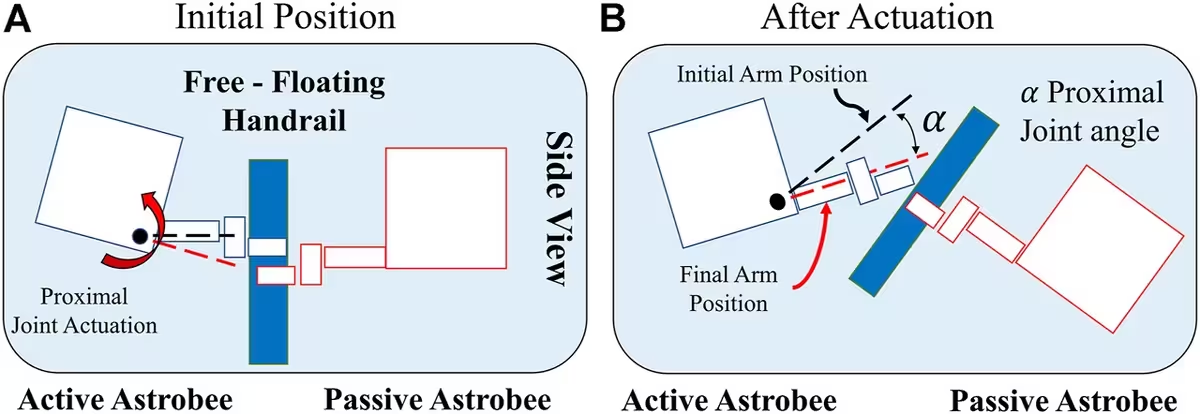 The Astrobee "hop", side view. (A) The robot is anchored to a handrail with its perching arm coiled in. (B) On release, the stored elastic energy and a short nozzle burst together launch the robot across the module. Diagram adapted from Park, Albee and colleagues, Frontiers in Robotics and AI.
Astrobee grabs a handrail with its perching arm and folds itself in towards the rail, storing energy in the joint a bit like an archer drawing a bow. At the right moment it releases the gripper and fires its nozzles. The combination launches the robot across the module faster than its fans alone could, while spending less battery. With a careful sequence of grabs, coils and pushes, an Astrobee can swing through the station almost like a tiny acrobat moving between bars.
It looks playful, and it is, but the engineering point is serious. A station that supports a few astronauts can host a swarm of robots only if those robots are kind to the battery and friendly to the airflow. A hop uses far less energy than a long powered flight, and shifts the robot quickly between handrails so it spends less time in the middle of a hallway where an astronaut might need to swim past.
Off the Station and Back On Again
Space is hard on hardware. Cosmic rays scramble bits in memory. Cooling fans, which Astrobees are quite literally made of, get clogged with dust and human skin cells (the station's air is full of them). After two years of duty Honey came home for a service: it returned to Earth aboard SpaceX CRS-23 on 30 September 2021, was refurbished at Ames, and rode back up on Northrop Grumman CRS-19 in 2023. NASA astronaut Woody Hoburg unpacked it in October 2023 and watched the yellow cube undock, fly through Kibo and re-dock with no help. There is something quietly impressive about a robot that gets sent home for a service and then sent back out again.
The programme has changed shape too. In September 2025, NASA awarded Arkisys, a small Los Alamitos based space company, a reimbursable Space Act Agreement to take on day to day sustainment of the Astrobee platform aboard the ISS. NASA still owns the project; Arkisys handles the heavy lifting of keeping the bees flying through whatever the rest of the station throws at them. It is a quiet but telling step: a research robot that has matured enough to be operated as a service.
Why This Matters Beyond the ISS
NASA is open about the fact that Astrobee is also a rehearsal. As crewed missions push further from Earth, the gap between "press button" and "see result" grows. A radio command to Mars takes upwards of twenty minutes round trip. A station near the Moon, or a future habitat orbiting Mars, will need internal helpers that can keep an eye on things between crew shifts, take orders from the ground when the radio link is up, and quietly use their own judgement when it is not.
That is exactly the muscle ISAAC and the Astrobees are building. The agency's planned Gateway lunar space station may only host a human crew about six weeks of the year, but it still has to be maintained year round. Whoever owns that maintenance is going to be a small swarm of robotic caretakers descended in spirit, and in code, from three small cubes that have been buzzing around Kibo since 2019.
 The Astrobee mission patch. "ISS ROBOTIC FREE FLYER" arches across the top of a yellow bordered teardrop. An astronaut in a NASA spacesuit stands on the left. A cube shaped Astrobee free flyer with twin propulsion plumes hovers on the right in front of a stylised cupola style window. NASA Ames Research Center.
How to See the Hive
You will never quite see a small black robot inside the ISS from the ground. But you can see its home. The station passes overhead almost everywhere on Earth between 51.6 degrees north and 51.6 degrees south, which covers about 90 percent of the world's population. On a clear morning or evening it looks like a bright, fast moving star, brighter than anything else in the sky except the Sun and the Moon.
If you would like to spot it, check the next pass over your location and step outside a few minutes early. Watch the live tracker to see where the station is right this second, and have a look at who is currently on board the orbiting hive. Somewhere inside its walls, a small black cube with glowing blue eyes is reading a barcode, surveying a vent, or quietly recharging on its dock, thinking about its next move.
Things You Might Not Know
| Fact | Detail |
|---|---|
| Heritage | The Astrobee family traces back to a Star Wars scene that an MIT professor, David Miller, showed his class in the late 1990s. The class built SPHERES; SPHERES grew up into Astrobee. |
| The fourth, fifth and sixth bees | Three ground twins at Ames are called Wanna Bee, Bee Sharp and Killer Bee. They are used for software, hardware and air bearing table testing before changes fly. |
| First powered flight | Bumble's first powered flight in space was on 14 June 2019, with Canadian Space Agency astronaut David Saint-Jacques in attendance. |
| First multi robot autonomy | On 7 April 2022 Bumble mapped Harmony while Queen captured the station's first interior 360 panorama, both with no astronaut in the room. |
| Big off button | Each Astrobee has a physical Terminate Button on its body. One press cuts power to propulsion and payloads while leaving the radios alive. |
| Honey came home | Honey rode SpaceX CRS-23 back to Earth on 30 September 2021 for a refurb, and was unpacked back on station in October 2023 after launching on Northrop Grumman CRS-19. |
| New caretaker | Since September 2025, the Astrobee platform's day to day operations on the ISS have been run for NASA under a Space Act Agreement with Arkisys of Los Alamitos, California. |
| Naming theme | The Astrobee name was picked through a top coder competition. The individual robot names came out of a brainstorm at NASA Ames. |
| Education first | MIT's Zero Robotics competition switched from SPHERES to Astrobee around 2022. Hundreds of school students now write code that runs on station. |
Related Reading
- Five Things You Didn't Know About the International Space Station a quick tour of the orbiting lab the Astrobees call home.
- Tracking the ISS: Why Its Orbit, Altitude and Speed Constantly Change the physics behind why the station has a "right" speed.
- Orbiting Awkwardly: Diplomacy on the Space Station how five space agencies share one orbital laboratory.
Sources: NASA's Astrobee programme page, NASA's "Honey Astrobee Returns to Space" article, NASA's "Meet ISAAC" feature, NASA's "Sticking Around: Astrobee Tests Gecko-Inspired Adhesives in Space", the ISS National Laboratory Upward magazine feature on Astrobee, and the Wikipedia article on Astrobee.