

UK Solar Eclipse 2026: Times, Safety and Where to Watch
On the evening of Wednesday 12 August 2026, the Sun over Britain will shrink to a thin golden crescent. Between roughly 88% and 96.5% of its face will be hidden behind the Moon, depending on where in the country you stand. It is the deepest solar eclipse seen from the UK since the total eclipse of 11 August 1999, almost exactly 27 years earlier, and nothing will match it again from British soil until 23 September 2090.
This page pulls together everything needed to watch it: the exact timings for every major UK city, how to view it without risking your eyesight, which eclipse glasses to buy and where, what to do if you have no glasses at all, and the astronomy groups running public viewing events, including Rosliston Astronomy Group in South Derbyshire.
What is actually happening
A solar eclipse happens when the new Moon passes directly between the Earth and the Sun and its shadow falls on the Earth's surface. The shadow has two parts. The dark central core, the umbra, is where the Moon blocks the Sun completely: stand inside it and you see a total eclipse. Around it spreads the much wider penumbra, where the Moon covers only part of the Sun's face.
On 12 August 2026 the umbra traces a narrow track across the Arctic, Greenland, western Iceland and northern Spain. The UK misses totality, but only just. The whole country sits deep inside the penumbra, which is why the coverage figures are so dramatic: around 90% in London and Manchester, 93% in Cardiff and Belfast, and more than 96% over the Isles of Scilly.
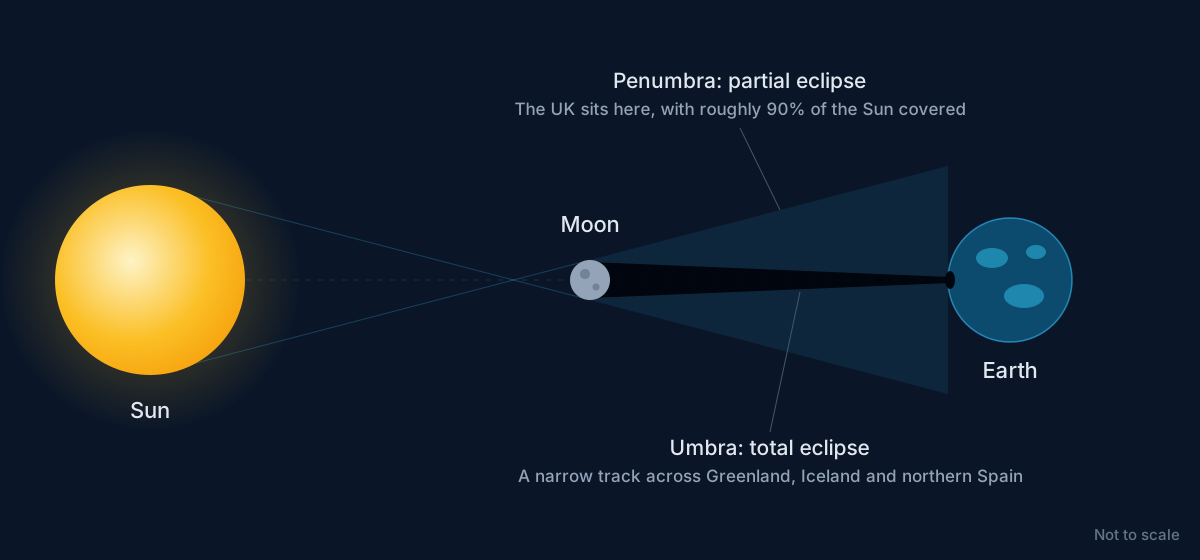 Why the UK sees a deep partial rather than a total eclipse. The narrow umbra touches Greenland, Iceland and northern Spain; the UK sits inside the wide penumbra. Diagram by issinfo.net.
The global moment of greatest eclipse comes at 5:46pm UTC (6:46pm BST), out near Iceland. By the time the show reaches its maximum over the UK, between about 7:05pm and 7:16pm BST, the Sun will already be sinking towards the west-northwest horizon, which shapes almost every piece of practical advice below.
Eclipse times for UK cities
All times below are British Summer Time (BST). The whole event lasts about 1 hour and 50 minutes from first contact, when the Moon takes its first bite out of the Sun's edge, to the moment the last notch disappears.
| City | Eclipse begins | Maximum | Sun covered | Eclipse ends |
|---|---|---|---|---|
| Edinburgh | 6:08pm | 7:05pm | 90.7% | 8:00pm |
| Glasgow | 6:08pm | 7:06pm | 91.4% | 8:00pm |
| Belfast | 6:10pm | 7:08pm | 93.1% | 8:03pm |
| Leeds | 6:12pm | 7:09pm | 90.8% | 8:03pm |
| Manchester | 6:13pm | 7:10pm | 91.4% | 8:03pm |
| Liverpool | 6:13pm | 7:10pm | 91.8% | 8:04pm |
| Sheffield | 6:13pm | 7:10pm | 91.0% | 8:03pm |
| Birmingham | 6:15pm | 7:11pm | 91.8% | 8:05pm |
| Cardiff | 6:16pm | 7:13pm | 93.2% | 8:07pm |
| London | 6:17pm | 7:13pm | 91.4% | 8:06pm |
| Truro | 6:18pm | 7:16pm | 95.0% | 8:10pm |
Timings compiled from BBC Sky at Night Magazine and the Royal Observatory Greenwich. Figures for towns between the cities listed differ by only a minute or two.
The extremes are worth a mention. The deepest view in the British Isles is from the Isles of Scilly, where 96.5% of the Sun disappears. The shallowest is from Shetland at 87.9%, which would still comfortably rank as the most striking eclipse in a generation on its own.
The catch: the Sun will be very low
The 1999 eclipse happened at breakfast time with the Sun well up in the sky. This one is different. At maximum eclipse the Sun will sit only about 9 to 13 degrees above the west-northwest horizon, roughly the height of a clenched fist held out at arm's length. By the time the eclipse ends, the Sun will be practically brushing the horizon, and in the south east it sets only 15 to 20 minutes later.
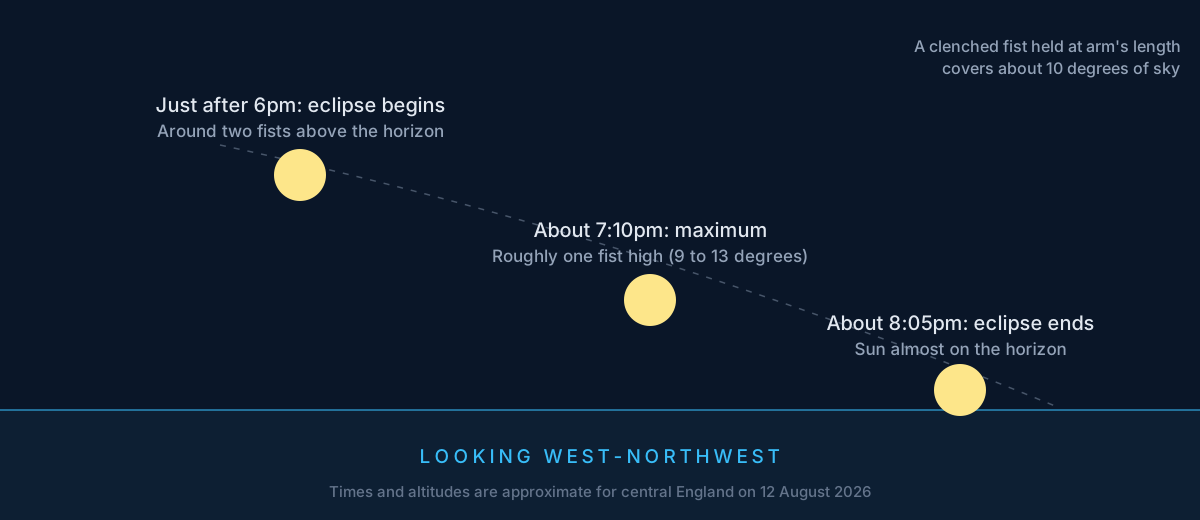 The whole eclipse plays out low in the west-northwest sky. Anything in the way, a hill, a treeline, a row of houses, hides it. Diagram by issinfo.net.
That makes location scouting the single most important preparation:
- Find somewhere with a completely unobstructed view to the west-northwest. Hilltops, coastal spots looking west, high open parkland and upper floors of tall buildings all work.
- Test the view the evening before. Stand in your chosen spot at 7pm on 11 August and check the Sun is clearly visible with nothing in the way. It will be within a degree or so of the same position 24 hours later.
- Have a backup spot in mind. Mid-August in the UK offers no better than about a 30% chance of clear skies in any one place, so being willing to drive towards a gap in the cloud can rescue the evening.
How to watch without damaging your eyes
The rule is simple and has no exceptions: never look directly at the Sun, even with more than 90% of it covered. The remaining sliver of the solar surface is just as intensely bright as the full Sun, and staring at it can burn the retina permanently and painlessly. There are no pain nerves in the retina, so the damage announces itself hours later.
The UK Health Security Agency published safety guidance ahead of this eclipse, and it aligns with what the Royal Observatory Greenwich and the Royal Astronomical Society advise:
- Use eclipse glasses certified to ISO 12312-2:2015, and only that. Ordinary sunglasses, welding goggles below shade 14, smoked glass, CDs, camera film and stacked sunglasses are all unsafe, no matter how dark they look.
- Inspect glasses before use. Scratched, creased, torn or punctured filters go in the bin.
- Keep the glasses on the whole time you face the Sun. Unlike a total eclipse, a partial eclipse never has a safe naked-eye phase.
- Supervise children constantly. The glasses must cover their eyes properly whenever they are looking up.
- Never point a camera, phone, telescope or binoculars at the Sun without a proper solar filter fitted over the front of the optics. Magnified, unfiltered sunlight destroys camera sensors and eyes alike, and eclipse glasses worn behind an eyepiece do not protect you.
Which eclipse glasses to buy, and where
Every safe pair of eclipse glasses carries the marking ISO 12312-2 (sometimes written in full as ISO 12312-2:2015). The problem is that the marking alone proves nothing, because counterfeit glasses print it too. The only reliable protection is buying from a reputable specialist supplier rather than an unknown marketplace seller.
The best starting point is ukeclipse.com, a national eclipse resource built for this event with the support of the Royal Astronomical Society, the British Astronomical Association and the Society for Popular Astronomy. Its eclipse glasses page maintains a directory of vetted UK retailers, including established astronomy shops such as First Light Optics. The Royal Observatory Greenwich shop also sells certified viewers, and many local astronomy societies have stocked up to sell or lend at their events.
Two days out, ordering online is now tight. If a delivery cannot arrive in time, the projection methods below need no equipment at all, and astronomy group events usually have filtered telescopes and spare glasses on hand.
No glasses? Project the Sun instead
Indirect viewing is completely safe, free, and genuinely fun, especially with children:
- Pinhole projector. Make a small, clean hole in a piece of card with a pin. With your back to the Sun, let sunlight pass through the hole onto a second piece of card, a wall or the pavement. The bright spot is a real image of the crescent Sun, and it sharpens as you move the cards apart.
- Colander. Hold a kitchen colander between the low Sun and any pale surface, and every hole projects its own tiny crescent. Dozens of eclipses at once.
- Tree shadows. Gaps between leaves act as natural pinholes. During the deep phase of the eclipse, the dappled light under any tree becomes a carpet of overlapping crescents. It is one of the strangest and most beautiful sights an eclipse offers.
And a screen is always safe. If projection is not your thing, the telescope live streams in the cloudy-weather section below show the crescent close up with no glasses needed at all.
Watch with an astronomy group
The single best way to experience the eclipse is alongside people with properly filtered solar telescopes, which show sunspots and the advancing lunar edge in detail no cardboard viewer can match. Astronomy societies across the country are running free or low-cost public sessions, and the national events map on ukeclipse.com plus the Go Stargazing events listing are the two most complete directories. Enter a postcode and both will surface everything nearby.
Rosliston Astronomy Group, South Derbyshire
For the South Derbyshire and East Staffordshire area, Rosliston Astronomy Group is running a public solar eclipse viewing session on Wednesday 12 August 2026 from 5pm to 8:30pm at Rosliston Forestry Centre, Burton Road, Rosliston, Swadlincote, DE12 8JX. The timing brackets the whole eclipse, from an hour before first contact through to past the final exit of the Moon.
There is a pleasing symmetry in the date. The group was founded in 1999, the year of the last great British eclipse, by Peter Bolas, and has spent more than a quarter of a century running public astronomy outreach from the Forestry Centre, where it now operates the Peter Bolas Observatory. It is a small registered charity funded by membership fees, and its twice-monthly Friday meetings are open to newcomers. Check the group's website before travelling for any booking or parking details.
Elsewhere in the country
A few examples of the many public sessions listed on the national directories:
- The Royal Observatory Greenwich in London hosts solar observing from 4pm, with booking recommended, alongside its free online live stream.
- Bristol Astronomical Society sets up at The Downs Sea Walls Viewpoint in Clifton, where around 93% of the Sun will be covered.
- Scarborough and Ryedale Astronomical Society hosts a session at Oliver's Mount with filtered solar telescopes, and the University of York pairs safe viewing with an astrophysics talk.
If nothing is listed near you, contact the closest society anyway. Many groups decide on informal gatherings in the final days once the weather forecast firms up.
If it is cloudy, or you cannot get outside
British weather respects no celestial schedule, so have a fallback. The Royal Observatory Greenwich live stream is free and broadcasts the entire eclipse from London with expert commentary. Streams from inside the totality track in Iceland and Spain will also show what the UK is narrowly missing: two minutes of darkness, the solar corona and stars at teatime.
For a more homegrown view, amateur astronomer Brett Johnson is live streaming the eclipse on YouTube through his telescope from Shinfield Ridge, near Reading in Berkshire. A properly filtered telescope shows the advancing lunar edge and any sunspots in detail the naked eye cannot match, and watching on a screen is completely safe: no eclipse glasses required.
Even under cloud, the eclipse will not pass unnoticed. With over 90% of the Sun covered, the evening light will turn noticeably dim and grey for half an hour around maximum, as if a dimmer switch were being slowly turned, and the temperature will ease back. Keep half an eye on the Met Office forecast during the day and be ready to move: a 20-minute drive to a break in the cloud is often the difference between seeing the crescent and seeing a photograph of it.
Stay out for the Perseids
The eclipse is only the first half of the evening's programme. A solar eclipse can only happen at new Moon, and that same new Moon leaves the night of 12 to 13 August completely moonless, which happens to be the peak night of the Perseid meteor shower, the most dependable meteor display of the year. It is the best-placed Perseid maximum in over a decade, precisely because the Moon is busy elsewhere.
The Perseids are debris from comet 109P/Swift-Tuttle, hitting the atmosphere at about 58 km (36 miles) per second. Predictions for this year vary: the Royal Observatory quotes a theoretical maximum of up to 150 meteors per hour, while International Meteor Organization models suggest Earth crosses a sparser part of the debris stream in 2026, putting realistic dark-sky rates closer to 30 to 50. Even the cautious figure means a meteor every minute or two.
No equipment is needed, and the eclipse glasses can finally come off; meteors are a naked-eye sight. The prime window runs from about midnight to 5:30am, but bright Perseids start appearing once the sky properly darkens. Find somewhere dark with an open view, lie back, give your eyes 15 minutes to adapt, and leave the phone in a pocket. The shower's radiant in Perseus never sets from the UK, so meteors can streak across any part of the sky. Anyone already parked somewhere dark with a clear horizon for the eclipse has, by accident, done the hard part of Perseid preparation too.
The next ones
Eclipse appetites, once whetted, need feeding. The UK gets another, smaller partial eclipse on 2 August 2027, when the Mediterranean sees one of the longest total eclipses of the century. After that the British diary thins out badly: the next total solar eclipse visible from the UK is on 23 September 2090, crossing the south coast of England with up to 2 minutes 37 seconds of totality. For most people reading this, 12 August 2026 is the deepest eclipse of a lifetime that does not involve booking a flight.
Things You Might Not Know
| Fact | Detail |
|---|---|
| The 27-year echo | The last deeper eclipse over the UK was the Cornwall total eclipse of 11 August 1999. This one arrives a day and 27 years later, on 12 August 2026. |
| Founded in eclipse year | Rosliston Astronomy Group was founded in 1999, the year of that last great British eclipse, and marks this one with a public viewing session at its Forestry Centre home. |
| Space names bookend it | The deepest British view, 96.5%, is from the Isles of Scilly near Bishop Rock; the shallowest, 87.9%, is from Shetland beside the SaxaVord Spaceport. |
| A retina has no pain nerves | Solar retinopathy, the burn caused by staring at the Sun, is painless while it happens. Symptoms such as blurred central vision appear hours afterwards, which is why the glasses rule has no exceptions. |
| Totality at teatime | Observers in western Iceland and northern Spain get a total eclipse in the early evening, with the corona visible while the UK, a few hundred kilometres outside the umbra, keeps a dazzling crescent. |
| Every leaf a projector | The gaps between tree leaves act as pinhole cameras, so the ground beneath any leafy tree during the eclipse fills with hundreds of tiny crescent Suns. |
A note for satellite spotters
The eclipse is, at heart, a transit: one body crossing the face of another. Satellite watchers chase miniature versions of the same event all year round, when the International Space Station crosses the Sun's disc in a fraction of a second. The ISS transit finder predicts exactly when and where those crossings are visible, using the same orbital geometry that lets astronomers predict eclipses centuries ahead. The solar system simulator shows the Sun, Moon and Earth alignment in 3D, and once the Sun has set on eclipse night, the next pass tool will tell you whether the ISS is due overhead in the darkening sky, with city-by-city times on the UK passes page.
Related Reading
- Predicting the ISS From a TLE: A Worked Example explains the orbital mechanics that make events like transits and eclipses predictable to the second.
- Tracking the ISS: Why Its Orbit, Altitude and Speed Constantly Change covers what keeps the station's path shifting while the Moon's stays clockwork.
- Starlink: The Megaconstellation Explained looks at the satellites you may spot once the eclipsed Sun finally sets.
Sources: the Royal Observatory Greenwich eclipse guide and live stream page, BBC Sky at Night Magazine's UK and Ireland eclipse guide, the UK Health Security Agency safety guidance, ukeclipse.com, the Go Stargazing listing for Rosliston Astronomy Group, the Royal Observatory's Perseid meteor shower guide, and the Wikipedia article on the eclipse.