

ISS Transit Finder: When will the ISS cross the Sun or Moon?
A transit happens when the International Space Station appears to pass directly in front of the disc of the Sun or the Moon. The event lasts about one second and is visible only from a strip of ground a few kilometres wide. Enter a location below or tap Use my location to find upcoming transits near you, see the centerline on a map, and get one-tap driving directions to the optimal viewing point.
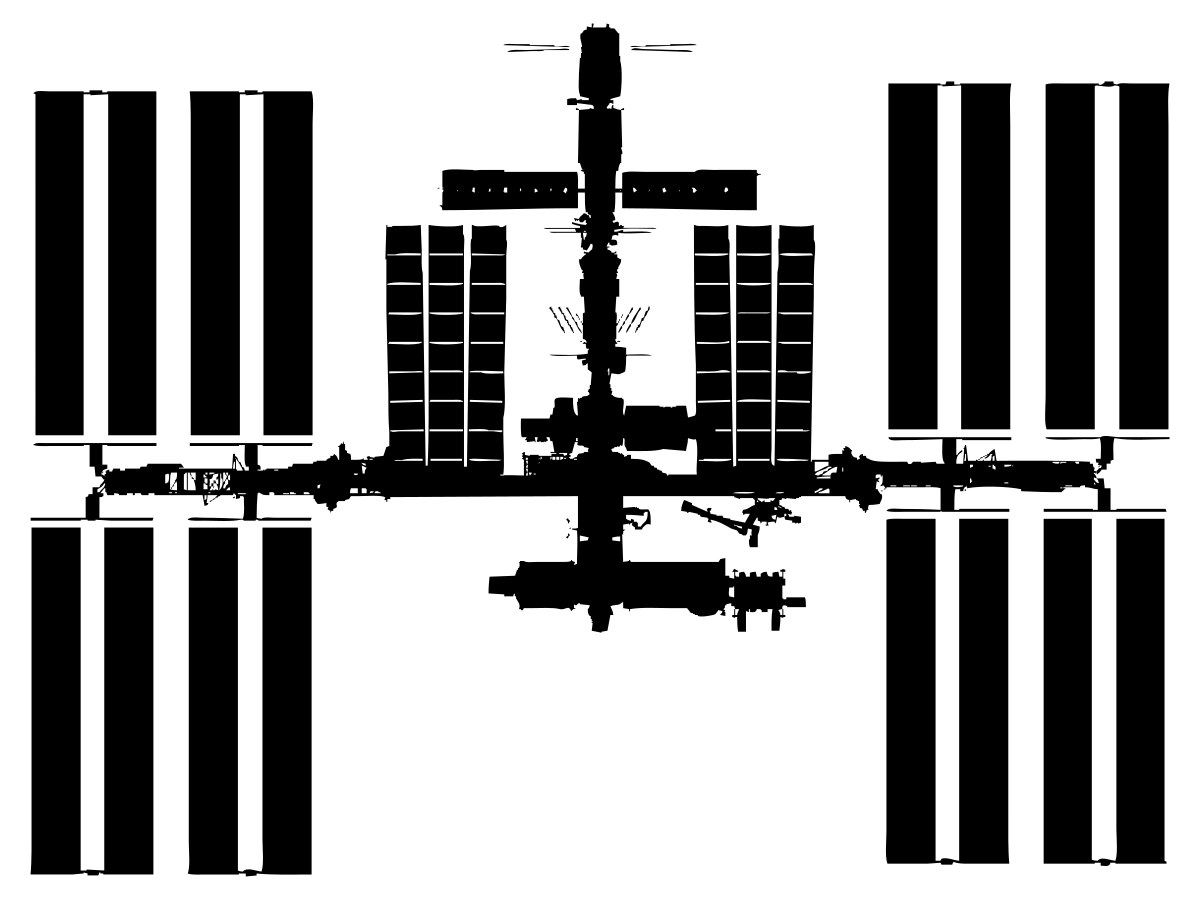
The finder also covers Tiangong, China’s space station. Both stations are large enough to show as a distinct silhouette in photographs taken with a telephoto lens; smaller satellites are available via the underlying API but not exposed here.
Looking for related tools and explainers? See Next Pass for visible-overflight predictions and the ISSInfo blog for deep dives into orbit data, tracking methods, and mission context.
How transit predictions work
The ISS orbits the Earth roughly every 92 minutes at ~7.66 km/s. From the ground that translates into an apparent motion across the sky of about 1 degree per second — fast enough that a transit across the Sun’s disc (half a degree wide) lasts on the order of one second.
We start from the most recent Two-Line Element set published by Space-Track.org and propagate the orbit forward using SGP4. For every minute of the search window we compute the apparent direction of the Sun and Moon from your location using Meeus’ low- and medium-precision algorithms, then look for moments when the satellite’s sky direction is within a small angle of either body.
Promising candidates are refined to sub-second timing using a golden-section search, then the on-ground centerline is computed by projecting the line from the body, through the satellite, onto the Earth’s surface. The point on that line nearest to you becomes the best viewing spot.
Reading the results
Chord type classifies how cleanly the satellite passes through the disc. Central means it crosses through the centre; grazing means it clips the edge; near-miss means it tracks just outside, where a small change in your position would put it back on the disc.
Distance and bearing tell you how far the centerline is from your location and in which direction. If the distance is below a kilometre you can walk; otherwise the Google Maps and Apple Maps buttons open ready-to-go driving directions.
Visibility is a heuristic combining body altitude, Moon phase, and ISS sunlight status. Toggle the “practically observable” checkbox off if you want to see every geometric event including those that occur with the Sun close to the horizon or a dim crescent Moon.
Frequently asked
What is an ISS transit of the Sun or Moon?
A transit happens when the International Space Station appears to cross in front of the disc of the Sun or the Moon as seen from your location. It looks like a tiny dark silhouette crossing the bright disc, and the entire event lasts about one second because the station is moving at ~7.66 km/s.
How accurate are these predictions?
The exact moment of a transit is sensitive to the orbital data we use. Predictions made today using a fresh TLE are typically accurate to within a few seconds of timing and a few hundred metres of centerline position. The further into the future you look the more drift accumulates, so refresh the page on the day of the event for the most precise window.
Why is the "drive distance" important?
The on-ground centerline — the strip from which the station appears to cross the centre of the disc — is only a few kilometres wide for the Moon and tens of metres wide for the Sun. Standing even a few hundred metres off the centerline means you will see a graze or miss the transit entirely. We compute the closest point on the centerline to you so you know whether it is a short walk or a long drive.
How do I photograph an ISS transit safely?
For solar transits you must use a certified solar filter on the front of your lens — never look at the Sun without one. For lunar transits no filter is needed; use a long focal length (400 mm or more), a fast shutter (1/1000 s) and burst mode timed to the second.
Why do some events show as "near-miss"?
A near-miss is a close pass where the satellite tracks just outside the disc rather than across it. We include these because the timing is still precise and a small change in your position would put the satellite back on the disc. Use the centerline distance to decide whether it is worth chasing.