

ISS Over Yangjiang Tonight
The next pass of the International Space Station over Yangjiang, China will be visible to the naked eye on Sunday 27 September at 20:26 GMT+8. It rises in the north-northwest and reaches a maximum elevation of 28 degrees above the horizon, a clear pass well above the horizon. The pass lasts about 1 min 10 sec. Look up and you should see a steady, bright white point of light moving smoothly across the sky.
Next visible ISS passes over Yangjiang
| When (local time) | Direction | Max elevation | Visible for | Brightness |
|---|---|---|---|---|
Sunday 27 September 20:26 GMT+8 | NNW → ESE | 28°Good | 1 min 10 sec | Faintmag 0.9 |
Monday 28 September 19:39 GMT+8 | NNW → ESE | 15°Fair | 3 min 10 sec | Faintmag -0.4 |
Tuesday 29 September 20:27 GMT+8 | NW → SSE | 56°Very good | 2 min 20 sec | Faintmag 0.9 |
Wednesday 30 September 19:40 GMT+8 | NW → SE | 61°Excellent | 4 min 50 sec | Brightmag -2.5 |
Thursday 1 October 18:52 GMT+8 | NNW → ESE | 28°Good | 7 min 20 sec | Brightmag -2.1 |
Thursday 1 October 20:29 GMT+8 | WNW → S | 12°Low | 3 min 20 sec | Faintmag 1.1 |
Friday 2 October 19:41 GMT+8 | NW → SSE | 25°Good | 6 min 50 sec | Faintmag -0.9 |
Saturday 3 October 18:53 GMT+8 | NW → SSE | 58°Very good | 10 min 10 sec | Brightmag -2.4 |
Showing the next 8 naked-eye visible passes over Yangjiang, in local time (Asia/Shanghai). A more negative magnitude is a brighter pass.
Can you see the ISS from Yangjiang?
Yes. The International Space Station is visible from Yangjiang several times a month, whenever it passes overhead during the hour or two after sunset or before sunrise while it is still catching sunlight against a dark sky. No telescope is needed; the station is one of the brightest objects in the night sky and is easily seen with the unaided eye. Your next good opportunity from Yangjiang is on Sunday 27 September at around 20:32 GMT+8, when the station climbs to 28 degrees above the horizon.
About the International Space Station
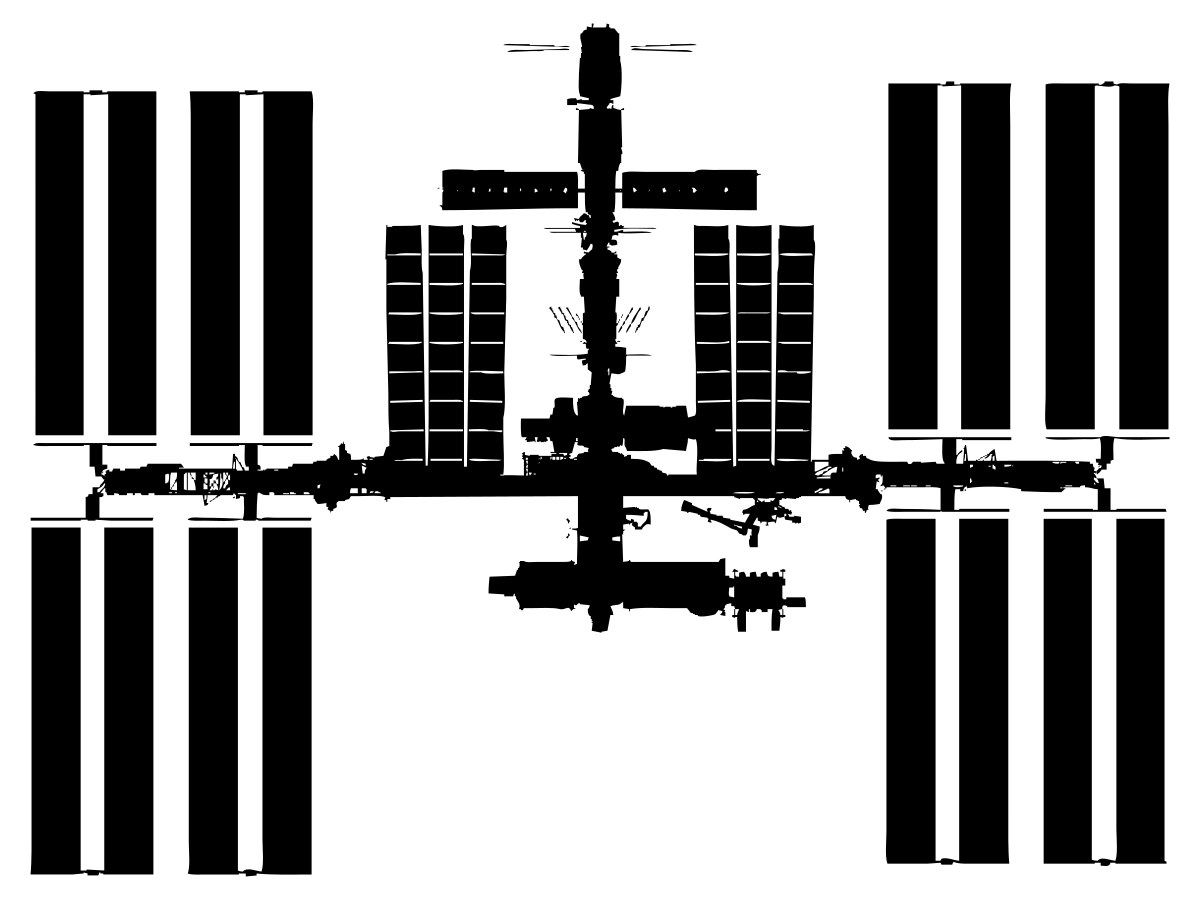
The International Space Station is the largest human-made structure in orbit, about the size of a football pitch and weighing roughly 420 tonnes. It circles the Earth at an altitude of around 420 kilometres and a speed of about 28,000 kilometres per hour, completing one orbit roughly every 90 minutes. That means the crew on board see around 16 sunrises and sunsets every day.
Because the station is so large and its solar panels are so reflective, it shines by reflected sunlight and can become one of the brightest objects in the night sky. It is visible from the ground without any equipment whenever it passes overhead during twilight, when the observer is in darkness but the station high above is still bathed in sunlight.
How to spot the ISS from Yangjiang
Find a spot with a clear view of the sky and as little light pollution as possible. A few minutes before the pass time listed above, look towards the rising direction shown for the pass. You do not need a telescope or binoculars; the station is easily bright enough to see with your eyes alone.
The ISS appears as a steady, bright point of light that glides smoothly across the sky. Unlike an aircraft it has no flashing or coloured lights. A pass lasts only a few minutes, and the station may suddenly fade and disappear partway across the sky as it crosses into the Earth’s shadow, so be ready and keep watching.
Frequently asked questions
- When can I see the ISS from Yangjiang?
- The next pass over Yangjiang is on Sunday 27 September at 20:26 GMT+8, rising in the north-northwest. The best times to look are during the dark hours just after dusk and just before dawn, when the station is lit by the Sun while the sky around you is dark.
- Which direction does the ISS appear from in Yangjiang?
- The International Space Station can rise from any point along the horizon, but most visible passes over Yangjiang begin in the western half of the sky and travel towards the east. Each pass on this page lists the exact rise and set directions.
- How bright is the ISS over Yangjiang?
- During a high pass the ISS can reach magnitude -3 to -4, brighter than any star or planet. It looks like a steady white dot moving across the sky over a few minutes. It does not blink or have coloured lights, which is how you tell it apart from an aircraft.
- Do I need a telescope to see the ISS from Yangjiang?
- No. The ISS is easily visible to the naked eye from Yangjiang. A telescope or binoculars are not needed and actually make it harder to follow because the station moves quickly across the sky.
Other cities in China
Nearby cities
- ISS over Changsha · China
- ISS over Maoming · China
- ISS over Yunfu · China
- ISS over Jiangmen · China
- ISS over Zhaoqing · China
- ISS over Zhongshan · China